- Open 24 Hours Mon–Sat
- contact@jkplumbingsf.com
- +1 (415) 359-4588
- CA License #1080266

In most San Francisco two-to-four unit buildings each flat has its own water heater, usually standing in a shared ground-floor garage. So one flat losing hot water while the others keep it is normal and points at that flat’s own unit. JK Plumbing repairs water heaters in flats across San Francisco and Daly City. Call (415) 359-4588.
By Alik, Owner & Master Plumber · Last updated November 2026
Why does one flat have hot water and another not?
The answer depends entirely on which kind of system the building has, and most residents don’t know which they’re in until something fails.
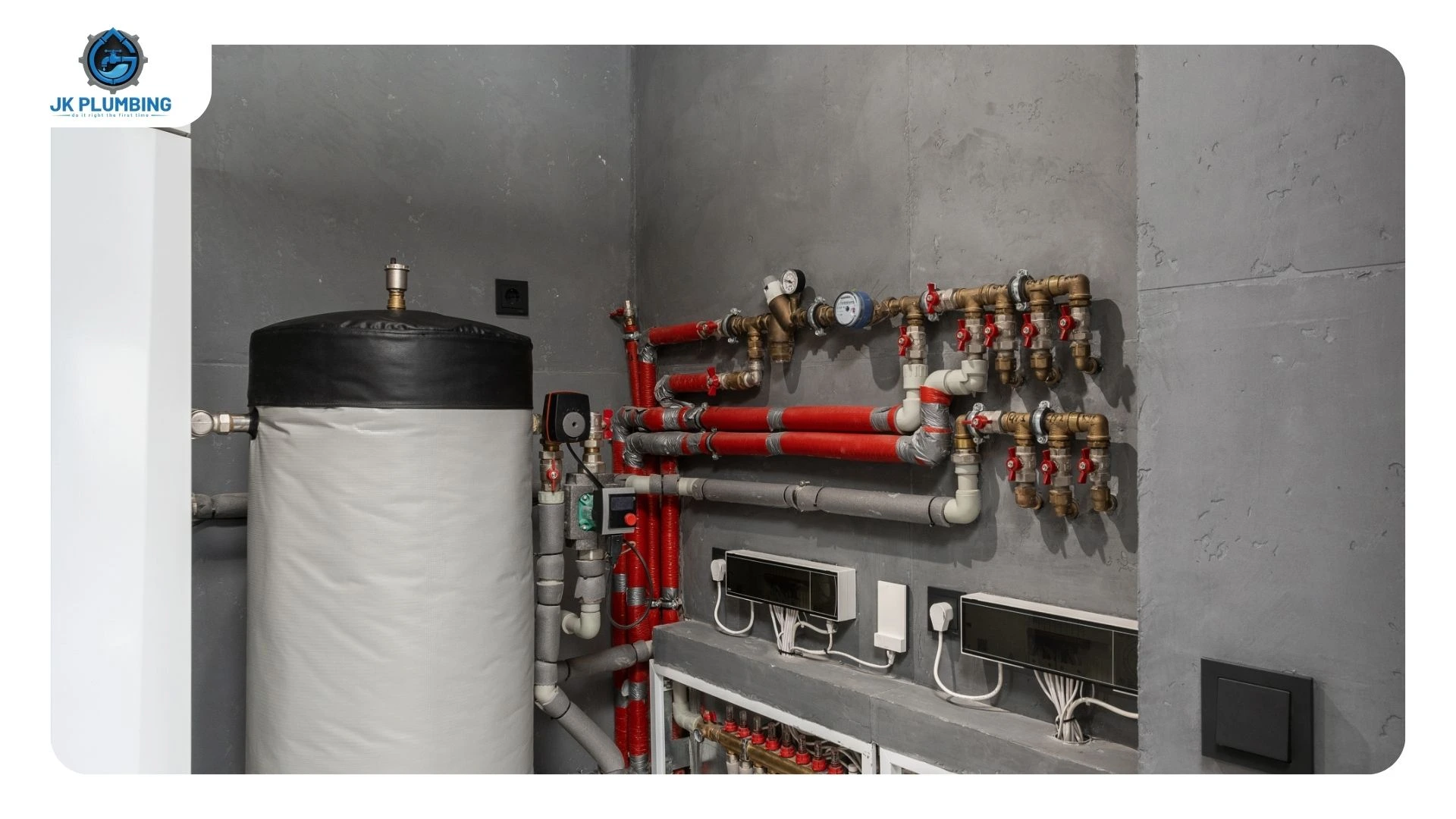
Separate units, shared room. This is the common arrangement in San Francisco’s two-, three- and four-unit buildings. Each flat has its own water heater, and they stand side by side in the ground-floor garage or a utility space. One flat going cold means that flat’s heater has a fault. The other units are unaffected because they were never connected.
One shared system. Less common in small buildings, more common in larger ones and in some converted properties. A single larger heater, or a bank of them, feeds every unit. Here a failure takes hot water from everybody at once — so if you’re the only flat without hot water, this almost certainly isn’t your situation.
The in-between case we see most often. A shared system that’s working, but one flat gets nothing or very little. That’s usually not the heater at all. It’s a fixture problem, a failed mixing valve, a crossover inside that unit, or a recirculation loop that isn’t reaching the far end of the building. What each water heater symptom means covers the heater-side faults, and when the problem isn’t the water heater covers the distribution side, which is where this one usually lands.
How to tell which you have in two minutes: go to the garage and count the heaters. If there are as many tanks as there are flats, you have separate units. If there’s one tank noticeably larger than a domestic unit, it’s shared. If there are two tanks and four flats, somebody paired them up at some point, and finding out which tank serves which flat is step one of any repair.
Whose heater is whose — and why the labels lie
In a shared garage with three or four tanks lined up, identifying the right one matters before anyone touches a valve.
Original labels are frequently wrong. Units get replaced one at a time over decades, by different plumbers, and the marker-pen label on the jacket often describes the arrangement from two owners ago. We’ve shut off a tank labelled for the upper flat and had the downstairs tenant call up to say their shower went cold.
The reliable method is tracing: follow the hot outlet from each tank and confirm at a fixture. It takes a few minutes and it prevents the most common avoidable problem in these buildings, which is interrupting the wrong household’s water.
If you’re an owner or manager in a building like this, having the tanks correctly labelled and the shutoffs identified is worth doing on a calm afternoon. It saves an hour on every future call-out, and in an emergency it’s the difference between isolating one unit and shutting the whole building down.
Can a unit in a closet or garage be repaired in place?
Nearly always, yes. Repair is far less constrained by access than replacement is, because a technician needs to reach the components rather than extract a five-foot tank.
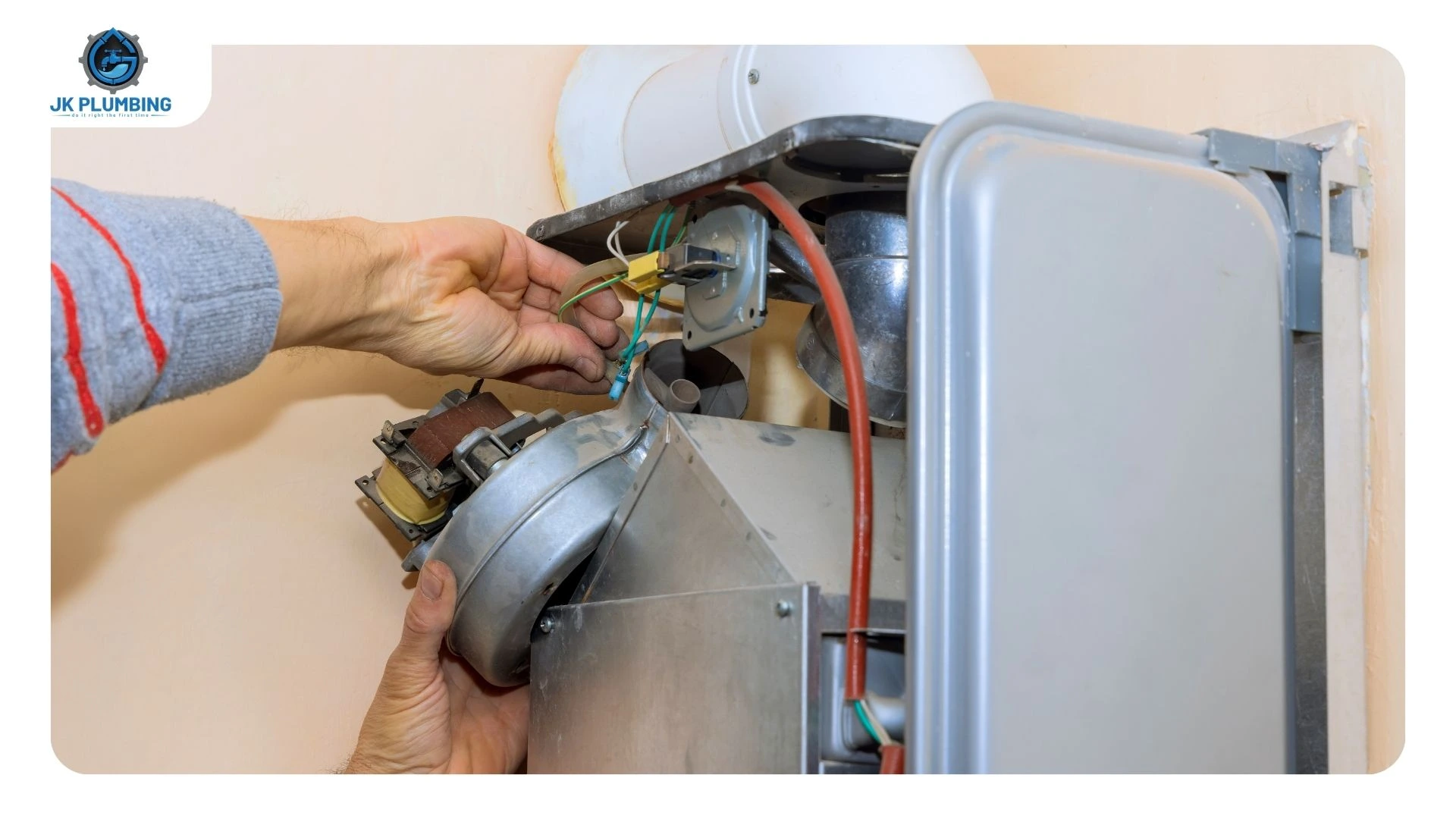
The parts behind most faults sit on the outside of the tank. Thermocouples, igniters, gas control valves, heating elements, thermostats and relief valves are all serviced from the front or the side. A unit wedged into a hallway closet or boxed into a light well is usually still perfectly serviceable in place.
Where access genuinely limits the work: clearance to pull a heating element straight out on an electric unit — they’re long, and a wall behind the access panel can stop you. Flushing a tank needs somewhere for the water to go, which is simple in a garage with a floor drain and awkward in an interior closet. And a gas control valve swap needs enough room to work safely on the gas connection.
The constraint we hit most in SF flats is the closet under the stairs — unit fitted during a conversion, door narrower than the unit, no light, no drain. Repairable, just slower.
Worth knowing: if a unit in that position reaches the end of its life, the access problem that was a mild inconvenience for repairs becomes the main cost driver for replacement. How older San Francisco homes complicate installation covers that side.
What changes when the system is shared
Three things, and they’re all about coordination rather than plumbing.
Everybody loses hot water during the work, not just the person who called. On a shared system, the repair interrupts the whole building. That needs notice to every unit, not just the one reporting the fault — and in a building with residents working from home or with young children, the timing genuinely matters.
Someone has to authorise it. On an individual unit the resident or owner decides. On a shared system the heater is usually common property, which makes it the HOA’s, the building owner’s, or the property manager’s decision. A tenant in one flat generally cannot instruct work on a shared system, however reasonable the request.
Sizing questions surface during the repair. When a shared system struggles under morning demand, residents often describe it as a fault. Sometimes it is. Sometimes the building’s hot water capacity was sized for different occupancy than it has now — a four-unit building that was two families and is now eight adults. We’ll say plainly which one we’re looking at, because repairing a unit that’s simply undersized doesn’t fix anything.
We work with owners, HOAs and property managers on these buildings, and we’ll send certificates of insurance where a building requires them before anyone works on site.
Who arranges the repair in a rented flat?
The landlord, in nearly every case — and in California this isn’t a matter of what the lease says.
Hot water is a habitability requirement. Under California Civil Code section 1941.1, a dwelling is considered untenantable if it lacks, among other things, a water supply with adequate hot water. That puts maintaining working hot water on the landlord as a statutory obligation, not a negotiable term. A lease clause purporting to shift that onto the tenant generally doesn’t hold.
How it works in practice: the tenant reports the fault in writing — email or text is fine and creates the record — and the landlord or property manager arranges and pays for the repair. When we’re called to a rented flat, the booking and the invoice normally come from the owner or the management company, even though the tenant is the one who met us at the door.
Tenants: a few practical notes. Report it in writing and keep a copy. Give access when it’s offered, since a missed appointment slows everything down. Don’t arrange the repair yourself and assume it’ll be reimbursed — California does have a repair-and-deduct remedy under Civil Code section 1942, but it has specific conditions and limits, and using it wrongly causes more problems than it solves.
If it isn’t getting fixed, that’s a dispute rather than a plumbing question, and the right places are the San Francisco Rent Board or a tenant counselling organisation, not your plumber. We can tell you what’s wrong with the heater and put that in writing. We can’t adjudicate who pays for it.
Owners and managers: the practical reason to move quickly on these is that a habitability complaint about hot water is considerably more expensive than a thermocouple.
How long does a repair take when access is tight?
For the common faults, less time than the access suggests.
A straightforward repair — thermocouple, igniter, element, thermostat, relief valve — runs about one to two hours once we’re on site, and we carry those parts. Difficult access adds time rather than changing the job.
What actually extends it in a flat building: identifying which tank serves which unit when the labels are wrong, waiting on access to a shared garage or a locked utility room, and coordinating notice when the work interrupts other units.
What we ask for in advance, because it’s what keeps these to a single visit: a photo of the data plate on the side of the unit, confirmation of how to get into the garage or utility space, and a contact for whoever can authorise the work if that isn’t the person meeting us.
Our emergency line answers around the clock Monday through Saturday, and for a building without hot water we’ll prioritise accordingly.
Where we work
Across San Francisco — the Mission, Noe Valley, Bernal Heights, the Sunset, the Richmond, Glen Park, Potrero Hill and the northern neighbourhoods — with most of our flat and multi-unit work in the two-to-four unit buildings that make up so much of the city’s housing. Also Daly City, Brisbane, South San Francisco and down the Peninsula to Burlingame.
One thing that works in these buildings’ favour: San Francisco runs on the soft Hetch Hetchy supply, so tanks here accumulate far less mineral scale than in harder-water parts of the Bay Area. When we do find heavy sediment in an SF tank, it usually means years without a flush or internal corrosion rather than scale — which matters, because the second one is a replacement conversation.
Our water heater repair page covers the service, and water heater replacement covers the other path.
Frequently asked questions
Why does one flat lose hot water while the others keep it?
Because in most San Francisco two-to-four unit buildings each flat has its own water heater, typically standing side by side in a shared garage. One flat going cold points at that flat’s own unit. If the building runs on a single shared system instead, a failure takes hot water from everyone at once — so being the only flat affected generally rules that out and points at a fixture, mixing valve or crossover inside your unit.
Can a unit tucked into a closet or garage be repaired in place?
Nearly always. The components behind most faults — thermocouples, igniters, gas control valves, elements, thermostats and relief valves — are serviced from the front of the tank, so a unit in a tight closet or light well is usually still serviceable where it stands. Access limits specific jobs rather than repair generally: pulling an electric element needs clearance behind the panel, and flushing needs somewhere for the water to go.
What changes when the system is shared between flats?
Three things. The repair interrupts hot water for the whole building, so every unit needs notice. Authorisation usually sits with the HOA, building owner or property manager rather than any individual resident, because the heater is common property. And what residents describe as a fault is sometimes a capacity problem — a system sized for different occupancy than the building now has.
Who normally arranges the repair in a rented flat?
The landlord. Under California Civil Code section 1941.1 a dwelling lacking adequate hot water is considered untenantable, which makes maintaining it a statutory obligation rather than a lease term. Tenants should report the fault in writing and keep a copy; the owner or management company normally books and pays for the work. If it isn’t being addressed, the San Francisco Rent Board or a tenant counselling organisation is the right route.
How long does a repair take when access is tight?
A common fault takes one to two hours on site once the right tank is identified. Tight access adds time rather than changing the work. In flat buildings the bigger delays are usually administrative — working out which tank serves which unit when labels are wrong, getting into a shared garage, and giving notice to other residents when the work interrupts them.
Visit or Call Us
JK Plumbing
Adress:1008 Edwards Rd Burlingame, CA 94010
Phone: (415) 359-4588
Hours: Open 24 hours, seven days a week.
Serving San Francisco, South San Francisco, Daly City, Brisbane and the Peninsula.
CA License #1080266
RECENT POSTS
Water Heater Services in San Francisco: Do You Need Repair, Replacement or Installation?
November 13, 2026
No Comments
Read More »
Water Heater Replacement in San Francisco: How Much Space Do You Actually Get Back?
November 12, 2026
No Comments
Read More »