- Open 24 Hours Mon–Sat
- contact@jkplumbingsf.com
- +1 (415) 359-4588
- CA License #1080266
A tankless unit that stops heating is usually telling you why — most display an error code before they quit. The code narrows the fault to a family, not a part, and the difference matters. JK Plumbing diagnoses and repairs tankless units across San Francisco and Daly City. Call (415) 359-4588.
By Alik, Owner & Master Plumber · Last updated October 2026
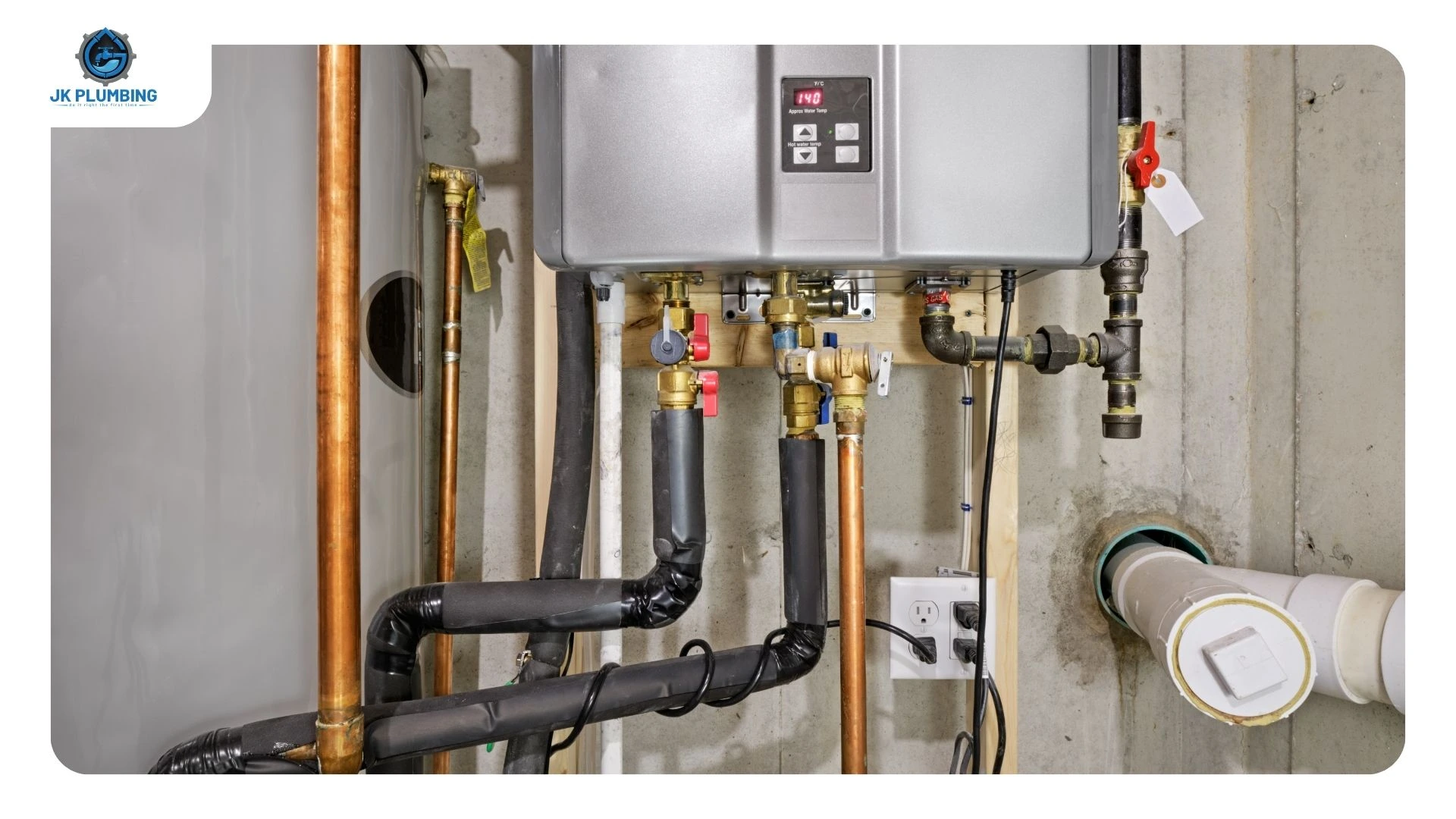
Why has a tankless unit stopped producing hot water?
Tankless failures work differently from tank failures. There’s no reservoir of already-heated water, so when something goes wrong you notice immediately and completely. The usual causes, roughly by how often we find them:
- Scale in the heat exchanger. Narrow passages, high temperatures, and minerals in the water. Scale restricts flow and raises exchanger temperature until the unit protects itself and shuts down.
- Ignition failure. The unit tries to light and can’t. Gas supply, gas pressure, a fouled burner, a failed igniter.
- Flame loss after ignition. It lights, then drops out. Usually a fouled flame sensing rod or a combustion air problem.
- Flow sensor faults. The unit never knows you’ve opened a tap, so it never fires. More on this below, because it’s often not a fault at all.
- Venting or air supply blockage. Intake or exhaust obstructed, a failed fan, or condensate backing up in a condensing unit.
- Gas supply that was never adequate. A unit that has always struggled under simultaneous demand may have an undersized gas line rather than a fault. That’s an installation problem showing up as a repair call.
And one that isn’t a fault: the cold water sandwich — a slug of cool water between two hot draws, caused by the unit cycling off and on between uses. It’s a characteristic of how tankless works, not a defect, though a recirculation setup reduces it.
What do tankless error codes actually mean?
Code numbers are manufacturer-specific — the same fault is a different number on a Rinnai, a Navien, a Noritz and a Rheem, which is why searching a bare code number often returns the wrong answer. What’s consistent is the families the codes fall into. Knowing the family tells you how urgent it is and whether it’s worth touching yourself.
Ignition failure. The unit attempted to light and failed, usually after several tries. Check first that the gas is actually on and that other gas appliances work — this is the one family where the cause is sometimes trivially outside the unit. Beyond that: gas pressure, burner condition, igniter.
Flame failure or flame loss. It lit and then lost the flame. Most often a flame sensing rod coated in residue, which is a clean-or-replace job rather than a major repair.
Overheat or high limit. The exchanger got hotter than permitted. Scale is the leading cause, followed by restricted flow and blocked venting. Don’t keep resetting this one — it’s a protection device doing its job, and repeated resets on a scaled exchanger shorten the unit’s life.
Flow or no-flow detected. The unit isn’t registering water movement. Could be the sensor, could be debris, could be that flow genuinely is too low. See below.
Venting and air supply. Blocked intake or exhaust, fan failure, pressure switch. On a condensing unit, a blocked condensate line can present here too.
Temperature sensor or thermistor. Erratic output temperature, or the unit reading a temperature it can’t reconcile.
Maintenance reminder. Some units flag a descaling interval rather than a fault. Worth knowing before paying for a diagnosis.
Two things to do with any code: write it down before clearing it, and note what you were doing when it appeared. A code that only shows up when two showers run is a different problem from one that shows up on a single tap, even when the number is identical.
Flow sensors, and the unit that won’t fire at low flow
This one generates a lot of service calls that don’t need a plumber.
Every tankless unit has a minimum activation flow — it won’t fire until enough water is moving through it, typically somewhere around half a gallon per minute depending on model. Below that threshold, nothing happens, by design.
So a tap that only ever runs at a trickle, or a showerhead that’s silted up, or a scaled aerator, can leave you with a unit that appears dead at one fixture and works perfectly at another. Before assuming the heater has failed, check whether it fires with a bath tap wide open.
When it is the sensor, it’s usually one of three things: debris on the impeller, a failed sensor, or an inlet filter screen that’s clogged — the last being a genuinely common maintenance item that costs very little to address and is often skipped entirely.
Descaling in San Francisco versus Daly City
These two cities are on different water, and it changes the maintenance interval.
San Francisco draws overwhelmingly from the SFPUC regional system — Hetch Hetchy surface water, which is soft. Tankless units here scale more slowly than in most of the Bay Area.
Daly City runs a blend: SFPUC surface water plus groundwater from the city’s own wells. Groundwater carries more dissolved mineral than the surface supply, so Daly City’s water comes out harder than San Francisco’s, generally reported in the moderately hard range, with the exact figure moving as the blend shifts through the year.
Practically: a tankless unit in San Francisco can often go longer between descalings, while a Daly City unit should be on an annual schedule. If you’re not sure, the error history tells you — a unit throwing overheat codes is scaling faster than it’s being serviced, whatever the calendar says.
Manufacturers commonly make documented descaling a warranty condition, so this is rarely optional in practice. For how hardness varies further down the Peninsula, tankless installation in Palo Alto, Los Altos and Mountain View covers the wider picture.
Is repairing a tankless unit worth it, or is replacement better?
Tankless economics differ from tank economics, and generally favour repair.
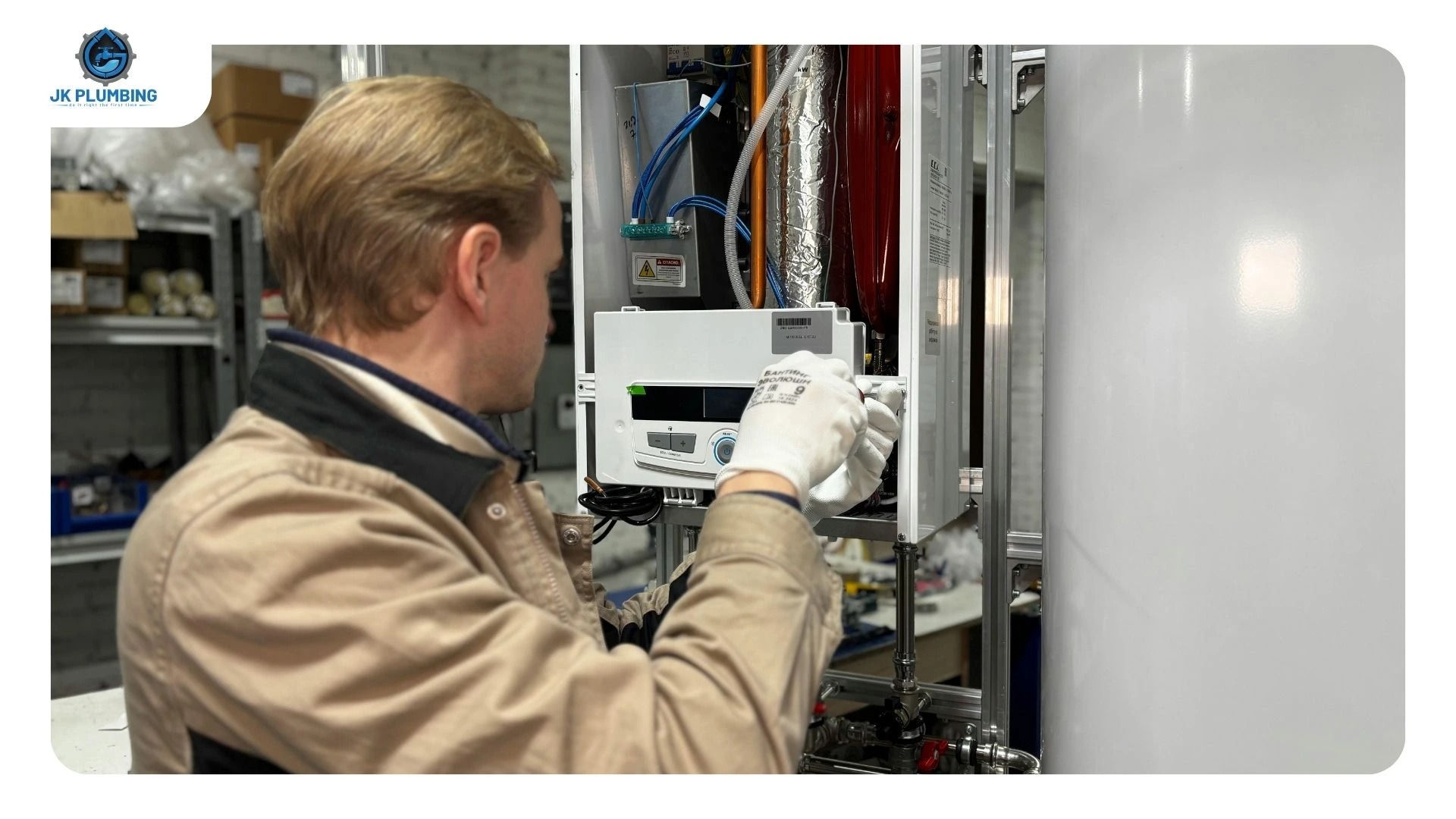
A tank has a service life of eight to twelve years and a failed tank is unrepairable. A tankless unit runs fifteen to twenty with maintenance, and almost everything on it is a serviceable component: igniters, flame rods, flow sensors, fans, thermistors, gas valves, control boards. A six-year-old tankless unit with a failed igniter is obviously worth fixing.
The exception is the heat exchanger. It represents most of the unit’s value, so a cracked or heavily scaled exchanger on an older unit is usually the point where replacement makes more sense — particularly if the scaling happened because the unit was never descaled, since a replacement exchanger in the same conditions will go the same way.
The other exception is a unit that was wrong from the start. If it has always underperformed under simultaneous demand, the problem may be gas line capacity or sizing rather than a component, and repairing parts won’t fix it.
If the diagnosis points at replacement, our water heater replacement page covers the options. If you’re dealing with a conventional tank rather than tankless, what each water heater symptom means in San Francisco is the equivalent guide for those.
Brands we service
Worth asking any contractor this before booking tankless work. Warranty repairs usually have to go through an authorized service provider, and using one who isn’t can cost you coverage on a unit still inside its term.
Where we work
San Francisco — the Sunset, the Richmond, Noe Valley, Bernal Heights, the Mission, Glen Park and the northern neighbourhoods — plus Daly City, Brisbane, South San Francisco, Burlingame and down the Peninsula.
Our water heater repair page covers the service itself.
Frequently asked questions
Why has a tankless unit stopped producing hot water?
Most often scale in the heat exchanger triggering a shutdown, ignition failure, flame loss after ignition, a flow sensor not registering water movement, or a venting blockage. A unit that has always struggled under simultaneous demand may have an undersized gas line rather than a fault. Check the error code and note what you were doing when it appeared.
How often does a tankless water heater need descaling?
It depends on your water. San Francisco is on soft Hetch Hetchy supply and units here can often go longer between services. Daly City blends in groundwater from its own wells and is harder, so annual descaling is the sensible default there. Manufacturers commonly require documented servicing to keep the warranty valid.
What do the error codes on a tankless unit actually mean?
Code numbers differ by manufacturer, but they fall into consistent families: ignition failure, flame loss, overheat or high limit, flow or no-flow detected, venting and air supply, temperature sensor, and maintenance reminders. The family tells you how urgent it is. Overheat codes in particular shouldn’t be repeatedly reset, because the protection is responding to a real condition.
Does hard water shorten the life of a tankless unit?
Yes, if it isn’t managed. Tankless heat exchangers have narrow passages at high temperature, which is close to ideal for mineral deposition — more so than in a tank, where scale settles harmlessly on the bottom for years. With regular descaling and, in harder water, pre-treatment, a tankless unit reaches its normal fifteen to twenty year life. Without it, the exchanger is what fails.
Is repairing a tankless unit worth it, or is replacement better?
Usually worth repairing. Most components — igniters, flame rods, flow sensors, fans, thermistors, gas valves, control boards — are serviceable, and tankless units last fifteen to twenty years. The exception is the heat exchanger, which carries most of the unit’s value; a cracked or heavily scaled exchanger on an older unit is normally the point to replace.
Visit or Call Us
JK Plumbing
Adress:1008 Edwards Rd Burlingame, CA 94010
Phone: (415) 359-4588
Hours: Open 24 hours, seven days a week. Serving San Francisco, Daly City, Brisbane, South San Francisco and the Peninsula.
CA License #1080266
RECENT POSTS
Hot Water Heater Replacement in San Francisco: Tank, Tankless or Upgrade?
October 29, 2026
No Comments
Read More »
Water Heater Replacement Near Me: San Francisco and Pacifica
October 28, 2026
No Comments
Read More »