
- Open 24 Hours Mon–Sat
- contact@jkplumbingsf.com
- +1 (415) 359-4588
- CA License #1080266

Most sewer lateral failures here come down to two things: clay pipe that has outlived its design life, and tree roots finding the joints. JK Plumbing diagnoses with a recorded camera survey before recommending anything, and repairs by trenchless or open-cut depending on what the pipe actually needs. Call (415) 359-4588.
By Alik, Owner & Master Plumber · Last updated October 2026
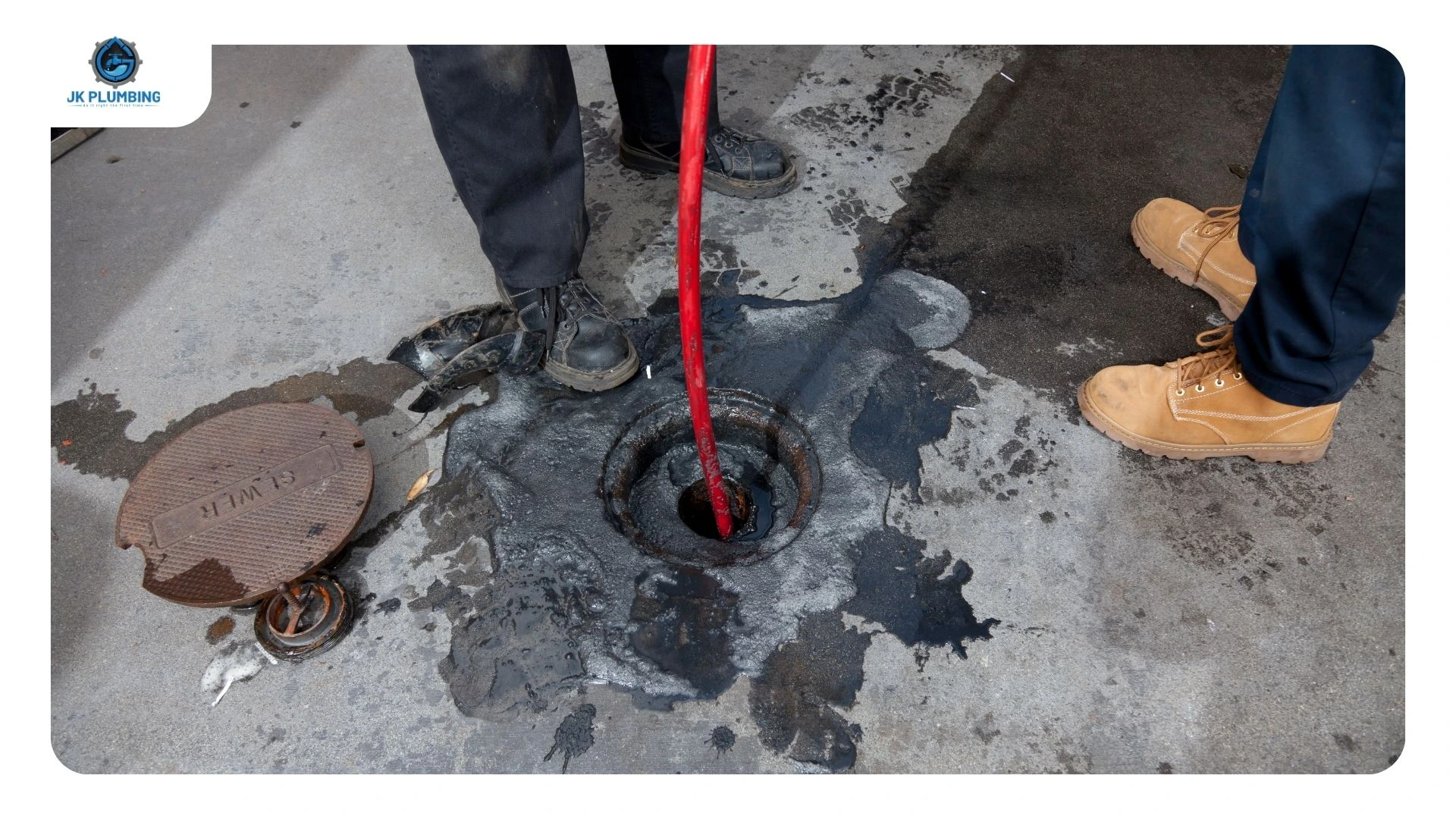
How do you know if a sewer line is broken?
Laterals rarely fail without warning. The signals, roughly in the order they appear:
- Slow drains across multiple fixtures. One slow sink is a fixture problem. Slow drains at several fixtures, especially the lowest ones in the house, points at the main line.
- Gurgling from a toilet or tub when another fixture drains. Air being displaced past a partial blockage.
- Backups that come back. A line cleared twice in a year isn’t a clog problem. Something structural is catching debris.
- Sewage odour outdoors, especially near a cleanout or along the lateral run.
- A patch of lawn that’s greener, softer or sunken than the ground around it, following the pipe route. Leaking effluent fertilises and undermines at the same time.
- Unexplained damp or settling near the foundation on that side of the house.
- Rodent or insect activity appearing indoors. Rats find breaks in clay laterals and follow them.
Any two of these together is worth a camera survey rather than another rodding.
Clay laterals in older Palo Alto homes
Vitrified clay was the standard material for residential sewer laterals until roughly the 1970s. If your Palo Alto home predates that — most of Professorville, Old Palo Alto, Crescent Park, Downtown North and College Terrace — there’s a good chance the original clay is still in the ground.
Clay itself is remarkably durable. It doesn’t corrode and it doesn’t degrade chemically. What fails is the joints. Clay pipe was laid in short sections with bell-and-spigot connections sealed with mortar, and every joint is a potential entry point once the seal deteriorates. Typical service life lands around 50 to 60 years, which means a 1940s or 1950s lateral is comfortably past it.
Ground movement makes it worse. Clay is rigid and brittle — it doesn’t flex, it offsets or cracks. Decades of seasonal soil movement produce small misalignments at the joints, and those misalignments are exactly what roots exploit.
The practical point: if you have a pre-1970s home and have never had the lateral surveyed, you don’t know its condition, and age alone is a reasonable trigger to look.
Do tree roots cause most sewer trouble in Palo Alto?
In older neighbourhoods with clay laterals, yes — and Palo Alto has more of the relevant trees than almost anywhere comparable.
Roots don’t break into sound pipe. They find existing openings, which is why clay joints are the target. A root hair enters through a failed mortar joint or a hairline offset, finds consistent moisture and nutrients, and thickens over years until it fills the pipe and catches everything passing through. By the time it causes a backup, the root mass has usually widened the opening it came through.
Here’s the Palo Alto complication most homeowners don’t see coming. The city’s Tree Protection Ordinance, substantially expanded in 2022, roughly tripled the number of protected trees — from about 81,720 to around 224,100, more than a third of the roughly 600,000 trees in the city. Coast live oak and valley oak are protected at 11.5 inches trunk diameter, coast redwood at 18 inches, bigleaf maple, incense cedar, blue oak and California black oak at 11.5 inches, and other mature species at 15 inches. Every street tree is protected regardless of size or species.
Two consequences for sewer work:
You usually can’t remove the tree. Removal of a protected tree requires a permit on narrow grounds, so “take the oak out and replace the pipe” is generally not the available solution even when the oak is unambiguously the cause.
You often can’t trench normally near it either. The city’s Tree Technical Manual governs trenching, excavation and equipment use inside a protected tree’s Tree Protection Zone, including requirements around root buffers, root pruning and air excavation methods instead of a standard trencher. The zone is calculated from trunk diameter and can reach well past the visible dripline — worth confirming with Palo Alto Urban Forestry for your specific tree before planning any excavation.
This is why the method conversation in Palo Alto is different from most places. Elsewhere, trenchless is about saving a lawn. Here it’s frequently about the work being permissible at all.
What is trenchless sewer repair?
Trenchless means replacing or rehabilitating the pipe without opening a continuous trench along its length. Two methods, and they suit different failures.
Pipe bursting. A bursting head is pulled through the existing pipe, fracturing the old clay outward into the surrounding soil while drawing a new HDPE pipe in behind it. The result is a continuous, jointless pipe at full diameter or larger. It needs a launch pit at one end and a receiving pit at the other — so this is less digging, not no digging. For a root-destroyed clay lateral it’s usually the strongest option, because a jointless HDPE pipe removes the thing roots were exploiting in the first place.
CIPP lining. A resin-saturated liner is drawn or inverted into the existing pipe and cured in place, forming a new pipe inside the old one. Often achievable through existing access points with no new excavation at all. The limits are real: the host pipe has to be structurally continuous, significant offsets or a collapsed section rule it out, you lose a small amount of internal diameter, and every branch connection must be reinstated after curing.
Open-cut still wins in some situations — a collapsed line, a section with grade problems that need correcting, a route change, or a run short enough that the access pits would be most of the trench anyway. No liner corrects a sagging pipe holding standing water.
The camera survey decides which, not a preference. Intact alignment with root intrusion and cracked joints is a trenchless candidate. A sagging or collapsed section is not.
And in Palo Alto specifically, the method choice interacts with the tree question above. Two access pits placed outside a Tree Protection Zone will often be permissible where a continuous trench through it would not.
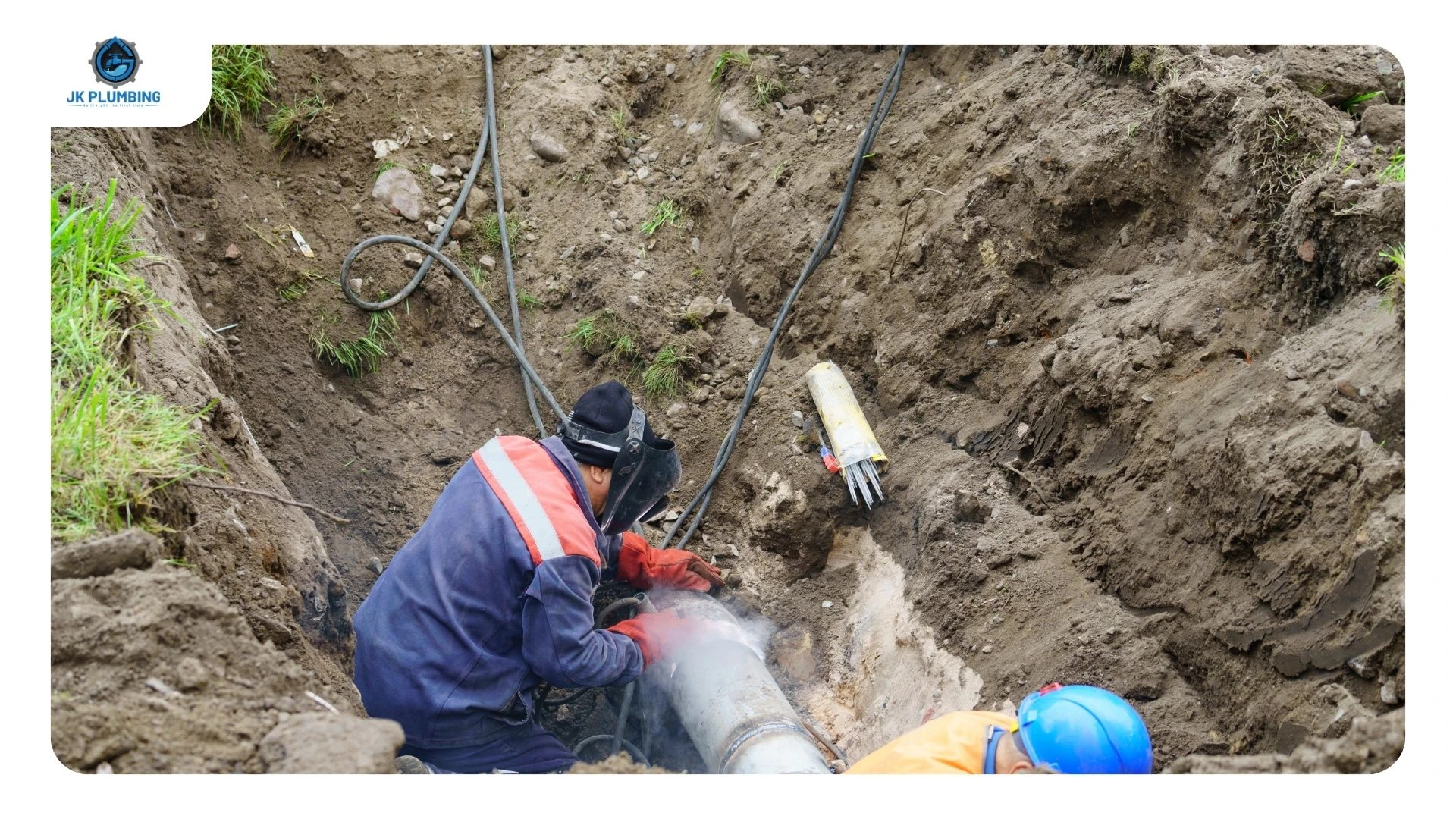
The camera survey comes first
We don’t quote a lateral replacement off a backup. Repeated backups have causes that aren’t a failed pipe, and replacing a sound lateral is an expensive way to discover that.
The sequence:
- Clear the line enough to see it. A camera can’t survey a pipe full of standing water or debris, so cabling or hydro jetting usually comes first.
- Survey the full run on camera, house to main, recorded. You watch the footage. If anyone tells you a pipe has failed without showing you, ask why.
- Locate and depth the defect with a sonde — so we know where it is, how deep, and what sits above it. On a Palo Alto lot that includes which trees are in range.
- Check whether the lateral is shared, which the survey usually reveals.
- Then recommend — and that’s sometimes a spot repair, a cleanout, or jetting on a schedule rather than a replacement.
If there’s no usable access point, sewer cleanout installation is its own fix first, and main sewer line cleaning covers the maintenance route where the pipe is sound.
What drives the cost of sewer line repair
We quote in writing after the survey, not over the phone, because the same length of pipe can be a straightforward job on one property and a complex one next door. What moves the number:
- Length and depth of the run. Depth matters more than length — deeper means more excavation, more shoring, more restoration.
- Method. Trenchless and open-cut price differently, and which is viable isn’t a choice so much as a finding.
- What sits on top. Lawn is cheap. Driveways, hardscape, mature planting and structures are not.
- Tree protection requirements. In Palo Alto, work inside a protected tree’s zone may require an arborist report and a tree protection plan before anything starts, plus slower excavation methods during. This is a genuine line item and it’s one almost nobody factors in when comparing quotes.
- Whether the work reaches the public right-of-way, which brings permits and restoration to city standards.
- Access. Equipment reach on a narrow lot, or a long carry, adds time.
Who pays for sewer lateral replacement covers the responsibility question, and our lateral sewer line replacement page covers the service.
Where we work
Palo Alto — Professorville, Old Palo Alto, Crescent Park, College Terrace, Downtown North, Midtown and Barron Park — plus Atherton, Menlo Park, Los Altos, Mountain View and Redwood City, and north through the Peninsula to Burlingame and San Francisco.
Atherton brings its own version of the problem: large lots mean long lateral runs from house to street, long runs mean more joints, and the mature oaks and redwoods those properties are known for sit directly over many of them. Long clay laterals under heavy canopy are close to a worst case, and they’re also where a camera survey pays for itself fastest — a spot repair found early beats a full replacement found late.
Frequently asked questions
What are the early signs of a failing sewer line?
Slow drains at several fixtures at once, gurgling from a toilet or tub when something else drains, backups that recur after clearing, sewage odour outdoors near the lateral run, and a strip of lawn that’s greener, softer or sunken along the pipe route. Any two together warrant a camera survey rather than another rodding.
Do tree roots cause most sewer line trouble in Palo Alto?
In older neighbourhoods with clay laterals, they’re the leading cause. Roots don’t break sound pipe — they enter through failed mortar joints and small offsets, then thicken until they fill the line. Palo Alto’s expanded tree ordinance means the tree responsible is often protected and can’t simply be removed, which makes the repair method choice more important here than in most cities.
What does sewer line repair cost in Palo Alto?
It depends on the length and depth of the run, whether trenchless or open-cut is viable, what sits above the pipe, whether the work reaches the public right-of-way, and — specific to Palo Alto — whether an arborist report and tree protection plan are required for work near a protected tree. We provide a written price after the camera survey rather than a phone estimate.
Can a sewer line be replaced without digging up the yard?
Largely, yes. Pipe bursting needs an access pit at each end of the run and leaves the ground between them undisturbed, and CIPP lining can sometimes be done through existing access points with no new excavation. Neither is truly dig-free, and neither works on a collapsed pipe or one with grade problems. In Palo Alto, placing access pits outside a Tree Protection Zone is often what makes a job permissible.
How long do clay sewer laterals last in older Palo Alto homes?
Typically 50 to 60 years. Clay doesn’t corrode, but its mortar joints deteriorate and the rigid pipe offsets with ground movement — and those joints are where roots get in. Any pre-1970s home that has never had its lateral surveyed is running on an unknown, and age alone is reason enough to look.
Visit or Call Us
JK Plumbing
Adress:1008 Edwards Rd Burlingame, CA 94010
Phone: (415) 359-4588
Hours: Monday–Saturday, open 24 hours.
Closed Sunday.
Serving Palo Alto, Atherton, Menlo Park, Los Altos, Mountain View and the Peninsula.
CA License #1080266
RECENT POSTS
Hot Water Heater Replacement in San Francisco: Tank, Tankless or Upgrade?
October 29, 2026
No Comments
Read More »
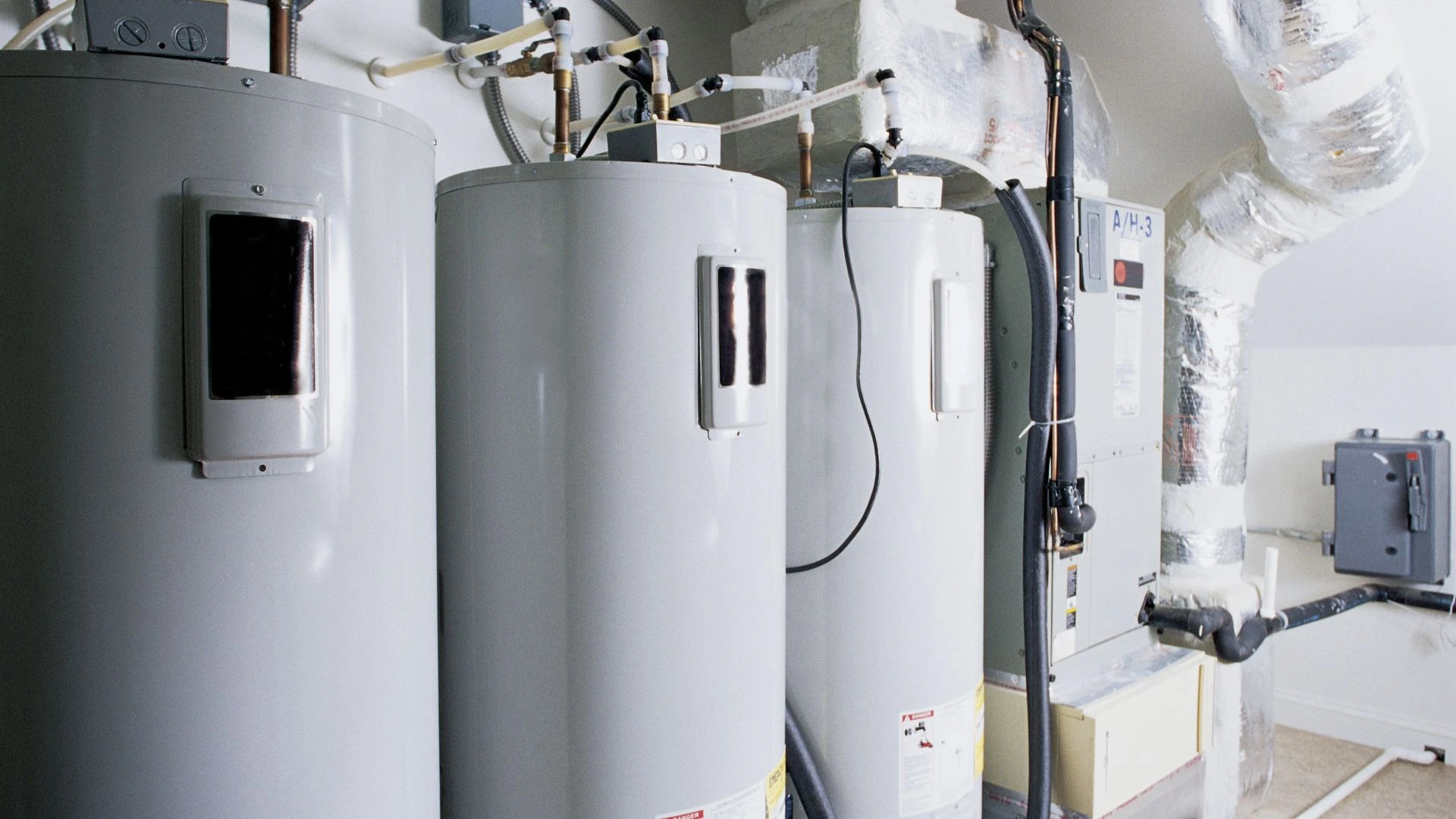
Water Heater Replacement Near Me: San Francisco and Pacifica
October 28, 2026
No Comments
Read More »