- Open 24 Hours Mon–Sat
- contact@jkplumbingsf.com
- +1 (415) 359-4588
- CA License #1080266
Main sewer line cleaning in San Francisco typically runs from around $300 for a straightforward cable clearing through an accessible cleanout to $1,200 or more for hydro jetting a root-packed line with a camera survey afterward. JK Plumbing answers 24 hours Monday through Saturday, and we tell you which one your line actually needs.
By Alik, Owner & Master Plumber · Last updated September 2026

What drives main sewer line cleaning cost in San Francisco?
Four things, and only one of them is the clog itself.
Cleanout access. This is the biggest variable in this city and the one nobody expects. A property with an accessible exterior cleanout is a straightforward job. A pre-war building where the cleanout is buried under a deck, paved over during a garage conversion, or simply never installed means pulling a toilet or accessing through a roof vent before any clearing starts. In parts of the Sunset and the Richmond we find laterals with no usable cleanout at all.
Cable or jetter. Cabling punches through a blockage and restores flow. Hydro jetting scours the pipe wall and removes the material. Different jobs, different prices, and the right answer depends on what’s in there.
Whether the line gets cameraed. On a first-time clog in a known-good line, often unnecessary. On a recurring backup, essential — otherwise you’re paying to clear the same blockage on a schedule.
Time of day. A Tuesday morning call and a 2am sewage backup are not the same job.
Our drain cleaning service page covers the full service menu. For a number on your property, call (415) 359-4588 and describe the symptoms — a licensed plumber picks up.
What are the signs your main sewer line is blocked?
The tell that separates a main line blockage from a single fixture clog is simple: more than one fixture is affected, and the lowest one goes first.
Watch for:
- Multiple fixtures backing up at once. A slow bathroom sink is a sink problem. A slow sink plus a gurgling tub plus a toilet that won’t clear is a main line problem.
- The lowest drain in the building floods first. A ground-floor shower, a basement floor drain, or a garage laundry standpipe. Water takes the path of least resistance, and that’s the lowest opening.
- Cross-talk between fixtures. Flushing the toilet makes the tub gurgle, or running the washing machine pushes water up through a floor drain. That’s air being displaced past a restriction.
- Toilets bubbling for no reason. Air escaping through the trap seal because it can’t vent normally.
- A smell outside near the cleanout, or soft wet ground along the lateral path.
If sewage is actively coming up through a drain, stop using water in the building entirely — every flush and every load of laundry adds to what’s already backing up. Then call.
“quickly diagnosed the exact location of the problem and explained everything clearly” — Google review, JK Plumbing customer
Before you pay: is the blockage even on your side?
Two San Francisco-specific situations where cleaning your line is the wrong spend, and both are worth ruling out first.
The blockage may be past the curb. Your lateral runs in two parts — upper, from the building to the curb, and lower, from the curb to the main. SFPUC guidance is that the lower section is reported through 311, and under most circumstances the city inspects and handles the work at no extra cost to you. A camera survey that reaches the property line tells you which side you’re on. We’ve covered who pays for what in the lateral in detail.
The backup may be the rain, not your pipe. San Francisco is the only coastal city in California with a combined sewer system — stormwater and wastewater move through the same network. SFPUC operates roughly 1,900 miles of mains and laterals, over 300 miles of which are more than a hundred years old. When an intense storm exceeds the system’s capacity, combined sewage can surcharge back onto private property, including basements and garages.
So the timing matters diagnostically. A backup that only ever happens during heavy rain, in a low-lying area, with no symptoms in dry weather, is a different problem than a root blockage — and jetting a clean pipe won’t fix it. The fix in that case is a backwater valve, which we install, and SFPUC’s Floodwater Grant program offers eligible property owners funding toward exactly that kind of flood resiliency work. Worth asking about if your property is in one of the known low-lying areas like the Folsom corridor, Lower Alemany in Bernal Heights, or West Portal near 15th and Wawona.
Neither of these costs you anything to check. Both can save you a bill.
Cable, jetter, or camera — what your line actually needs
A cable, or snake, drives a cutting head through the blockage and restores flow. It’s fast, it’s cheaper, and for a one-off obstruction it’s the correct tool. What it leaves behind is the material coating the pipe wall, which is why a cabled line with heavy grease or root growth often re-clogs within months.
Hydro jetting sends high-pressure water through the line to scour the wall clean rather than bore through the middle. It’s the right call when the same line keeps closing up, when a camera shows the pipe walls coated rather than obstructed at one point, or when a line needs to be clean before relining. Our hydro jet service page goes through the equipment and the six situations we use it for.
A camera survey is what makes the choice honest. We run the camera to confirm the cause, locate it by distance from the cleanout, and record it. That recording matters for three reasons: it tells you whether you’re looking at roots, grease, scale, or a structural failure; it tells you whether the defect sits before or past the curb; and it gives you something to hand a buyer, an agent, or an insurer.
If the camera shows a collapsed section or a badly offset joint, no amount of cleaning solves it and we’ll say so — that’s a lateral replacement conversation instead.
Clearing tree roots from clay and cast iron lines
Roots are the most common cause of main line blockage in San Francisco’s older neighborhoods, and the pipe material determines how the failure looks.
Vitrified clay doesn’t corrode, but it’s rigid and jointed. Roots find the joints, work in through the gap, and fan out into a mass inside the pipe. Jetting with a root-cutting nozzle removes the growth and scours the wall, but it doesn’t close the joint the roots came through — so the growth returns, on a timeline set by the tree. That’s a maintenance relationship, not a permanent fix, and you should be told that up front.
Cast iron fails differently. It scales from the inside, thinning and channeling until the bottom of the pipe erodes. Roots enter through corrosion failures rather than joints. A jetter clears the buildup and restores the original bore, which in a 60-year-old cast iron line can be a dramatic difference in flow.
The complicating factor in San Francisco is street trees. A lateral running past a decades-old root system on a flat block in Noe Valley or the Excelsior is under continuous pressure in a way a line in an open lot isn’t. Those properties are the ones that benefit most from being on a schedule rather than waiting for a backup.
How often should a main sewer line be cleaned?
It depends on what’s feeding the problem, not on a calendar.
- Homes with mature trees over the lateral path: annually. Catching root intrusion before it causes a backup is far cheaper than an emergency clear.
- Restaurants and commercial kitchens: quarterly, because of grease load.
- Pre-1980 buildings with cast iron drains: every one to two years once scaling has started showing up on camera.
- Newer PVC laterals with no trees and no history: no routine schedule needed. Clean it when something changes.
SFPUC separately recommends having a contractor inspect your lateral at least once every five years even with no symptoms, which is a reasonable baseline for any San Francisco property that hasn’t had a camera down the line.
If you’ve had two backups in twelve months, the schedule question is the wrong one. Get the camera in and find out why.
Main sewer line cleaning FAQ
How much does main sewer line cleaning cost in San Francisco?
As of September 2026, expect roughly $300 for cable clearing through an accessible cleanout, rising toward $1,200 or more for hydro jetting a root-packed line with a camera survey. The largest variable is cleanout access — pre-war buildings where the cleanout was paved over or never installed require access through a toilet or vent before any clearing begins. After-hours emergency calls are priced separately.
What are the signs my main sewer line is blocked?
Multiple fixtures affected at once, with the lowest drain in the building backing up first. Watch for cross-talk between fixtures — flushing a toilet makes a tub gurgle, or running the washing machine pushes water up through a floor drain. A single slow fixture is usually a local clog. Two or more, plus gurgling, points at the main line.
Do you use a camera survey to confirm the cause?
Yes. We run the camera to confirm what’s causing the blockage, locate it by distance from the cleanout, and record it. That tells you whether you’re dealing with roots, grease, scale, or a structural failure, and whether the defect sits before or past the curb — which determines who pays for the repair.
Can you clear tree roots from clay and cast iron lines?
Yes. Hydro jetting with a root-cutting nozzle removes root mass and scours the pipe wall in both materials. Be aware of the limit: jetting removes the growth but does not close the clay joint or the corrosion failure the roots entered through, so on a rooted line the growth returns. We’ll tell you whether you’re looking at a maintenance schedule or a replacement.
Do you offer emergency same-day sewer line service?
Yes. We answer 24 hours a day Monday through Saturday and prioritize dispatch for active backups where sewage is coming up through a drain. Closed Sundays for non-emergency work. Routine calls get a two-hour arrival window with a text when the truck is en route.
Visit or Call Us
JK Plumbing
Adress:1008 Edwards Rd Burlingame, CA 94010
Phone: (415) 359-4588
Hours: Monday–Saturday: Open 24 hours · Sunday: Closed CA License #1080266
Serving San Francisco and surrounding areas including Bernal Heights, Noe Valley, Glen Park, West Portal, the Sunset, the Richmond, and the Excelsior, plus Daly City, South San Francisco, Burlingame, and San Mateo.
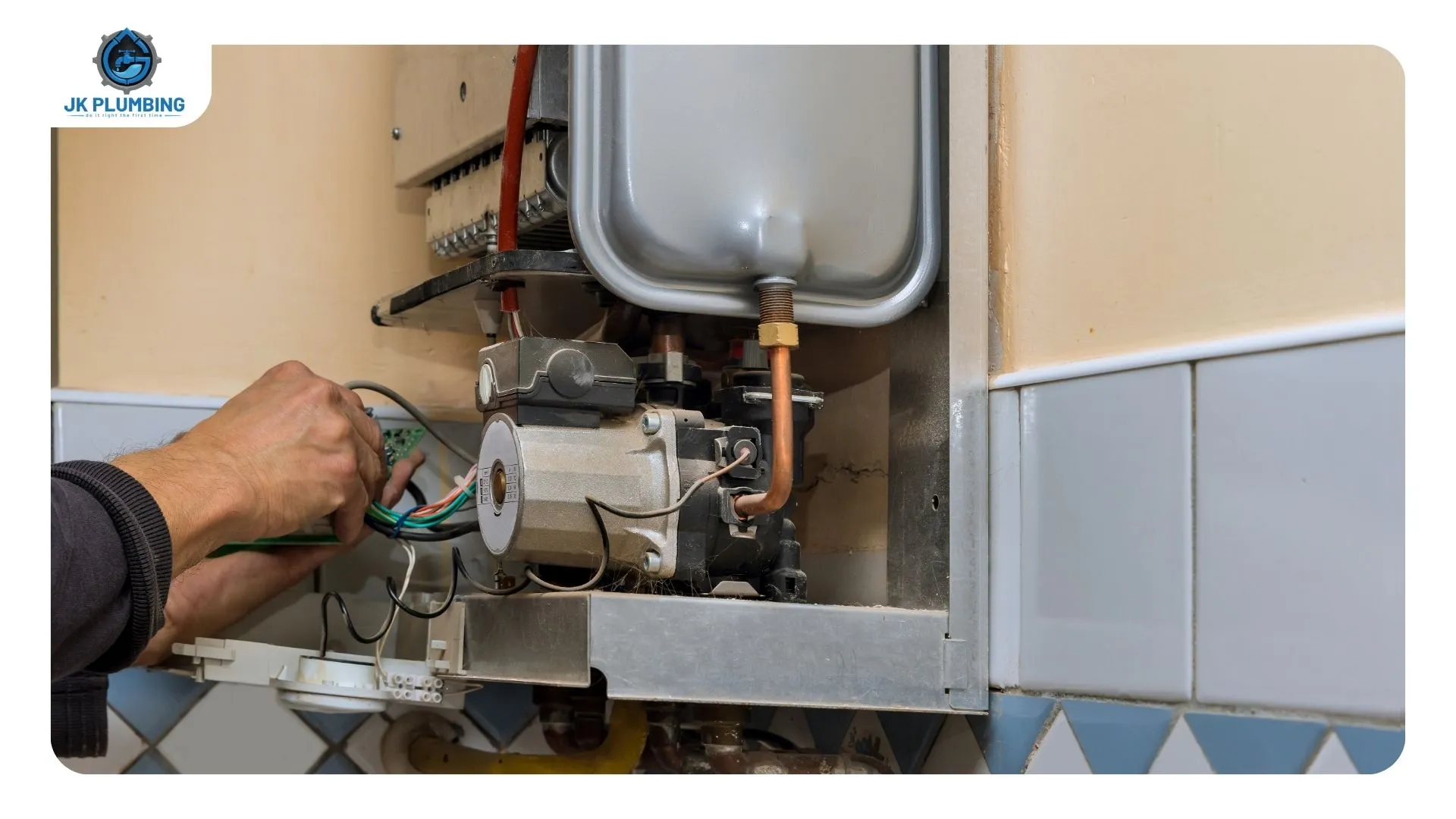
Where we work in San Francisco and on the Peninsula
We run water heater repair San Francisco-wide, including the Sunset, Inner and Outer Richmond, Noe Valley, Bernal Heights, the Mission, Potrero Hill, Glen Park, the Excelsior, Pacific Heights, the Marina, and SoMa, plus Daly City.
From the same Burlingame dispatch we cover the Peninsula corridor. If you’re south of the county line, our South San Francisco water heater repair visit guide walks through what a service call looks like, water heater repair in Palo Alto covers the hard-water side of the peninsula, and how often you need a water heater flush in San Mateo is the maintenance answer for everything south of Burlingame.
Water heater repair FAQ
How much does water heater repair cost in San Francisco?
Most component repairs run roughly $180 to $600 as of September 2026. A standard 50-gallon tank replacement is typically $2,800 to $4,500 installed; tankless and heat pump units cost more. Permit fees and code-required parts such as expansion tanks are quoted separately, in writing, before work starts.
Do you offer same-day water heater repair?
Yes. We answer 24 hours a day Monday through Saturday and dispatch same day for no hot water, leaking tanks, and gas-smell calls. Closed Sundays for non-emergency work. Non-emergency jobs get a two-hour arrival window with a text when the truck is en route.
Should I repair or replace my water heater?
Repair a component failure on a unit under about eight years old. Replace if the tank is leaking, the unit is past ten to twelve years, or the repair quote approaches half the cost of a new install. In San Francisco, add one question: does a current-spec tank still fit the original closet? That answer sometimes decides it for you.
Do you check seismic strapping when servicing a water heater?
Yes, on every visit — it’s the first thing a San Francisco inspector looks at on a replacement. California requires two straps on a tank water heater, one in the upper third and one in the lower third, with the lower strap positioned above the controls and anchored into framing. Drywall anchors fail inspection every time. If we find a unit strapped incorrectly, we tell you, whether or not you hired us for that.
Are you a bonded and insured plumbing contractor?
Yes. JK Plumbing holds CA Contractor’s License #1080266, active continuously since 2007, with the contractor’s bond California requires plus general liability and workers’ compensation. California requires a licensed contractor for plumbing work over $500. Certificates of insurance are available on request for HOAs and property managers, and you can verify the license yourself on the CSLB site before we start.
Visit or Call Us
JK Plumbing
Adress:1008 Edwards Rd Burlingame, CA 94010
Phone: (415) 359-4588
Hours: Monday–Saturday: Open 24 hours · Sunday:
Closed CA License #1080266
Serving San Francisco and surrounding areas including the Sunset, Richmond, Noe Valley, Bernal Heights, the Mission, and Potrero Hill, plus Daly City, Burlingame, San Mateo, and Palo Alto.
RECENT POSTS
Where to Install a Water Heater in a South San Francisco Home: What’s Allowed?
October 12, 2026
No Comments
Read More »
Who Can Change a Water Heater Quickly in South San Francisco?
October 9, 2026
No Comments
Read More »