- Open 24 Hours Mon–Sat
- contact@jkplumbingsf.com
- +1 (415) 359-4588
- CA License #1080266

Trenchless lateral replacement means two access pits instead of a continuous trench — not zero digging. Open-cut means a full trench along the pipe run. Which one suits your property depends on the pipe’s condition, its route, and what sits on top of it. JK Plumbing does both in San Francisco. Call (415) 359-4588.
By Alik, Owner & Master Plumber · Last updated October 2026
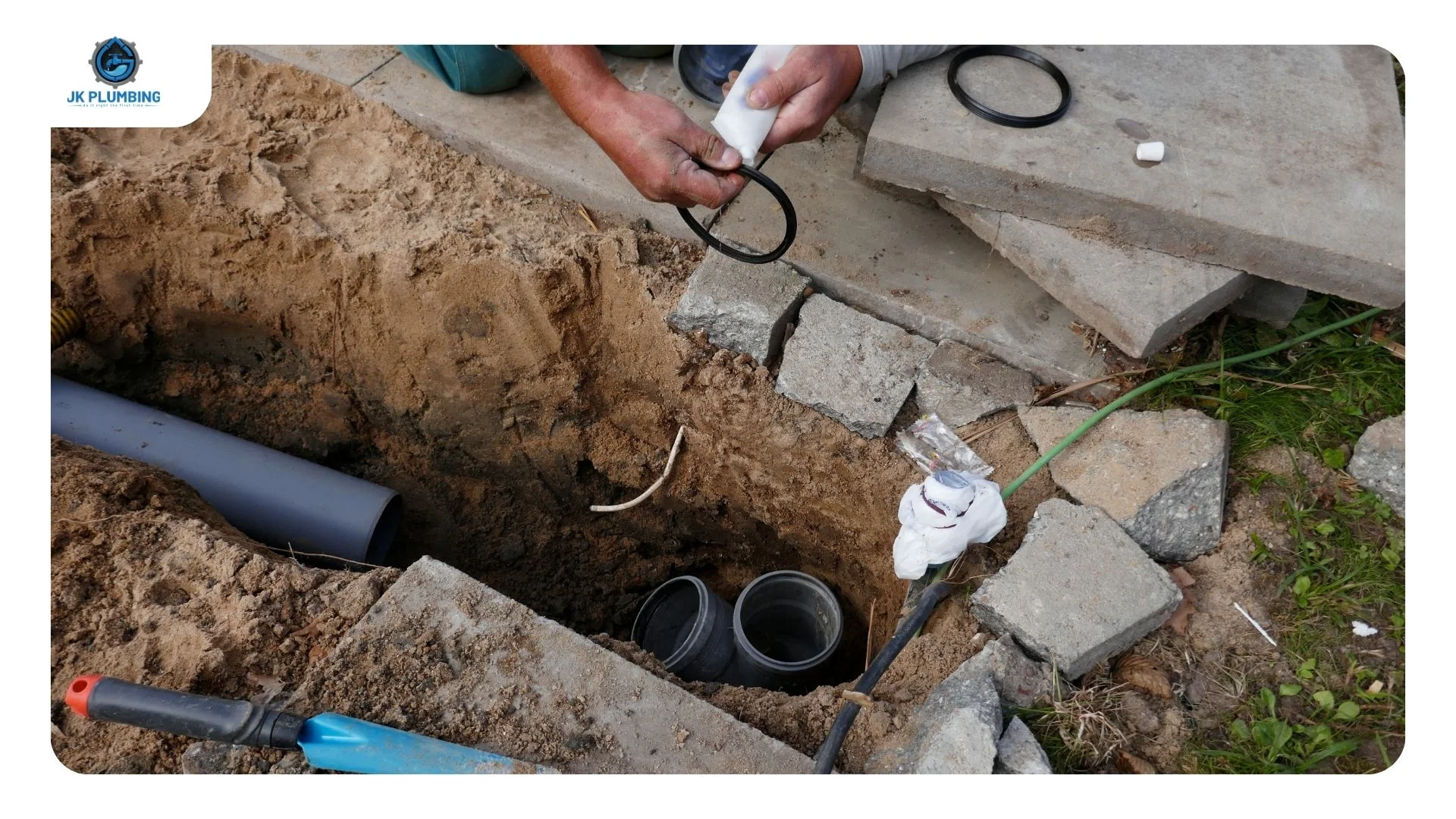
Will you have to dig up the driveway, garden or street?
The honest answer is: less than you fear, more than “trenchless” sounds like.
Every method needs access somewhere. The real question is how many holes and where.
Trenchless pipe bursting needs a launch pit at one end of the run and a receiving pit at the other. On a typical San Francisco lot that’s often one pit near the building or cleanout and one near the property line or in the sidewalk. The pipe between them stays undisturbed — so a mature garden, a finished driveway, a patio, or a set of front steps over the middle of the run survives intact.
CIPP lining can sometimes be done through existing access points with no new excavation at all, which is the closest thing to genuinely no-dig. It depends on there being a usable cleanout and on the host pipe being intact enough to line.
Open-cut means a trench along the length of the pipe. Everything above it comes up.
The part people are usually most worried about is the street and sidewalk, and that part is largely not optional. In San Francisco your lateral runs all the way to the main under the street. If the failure is in the lower section, something has to open at that end regardless of method — a pit for trenchless, a trench for open-cut. What trenchless saves you is the thirty or fifty feet in between.
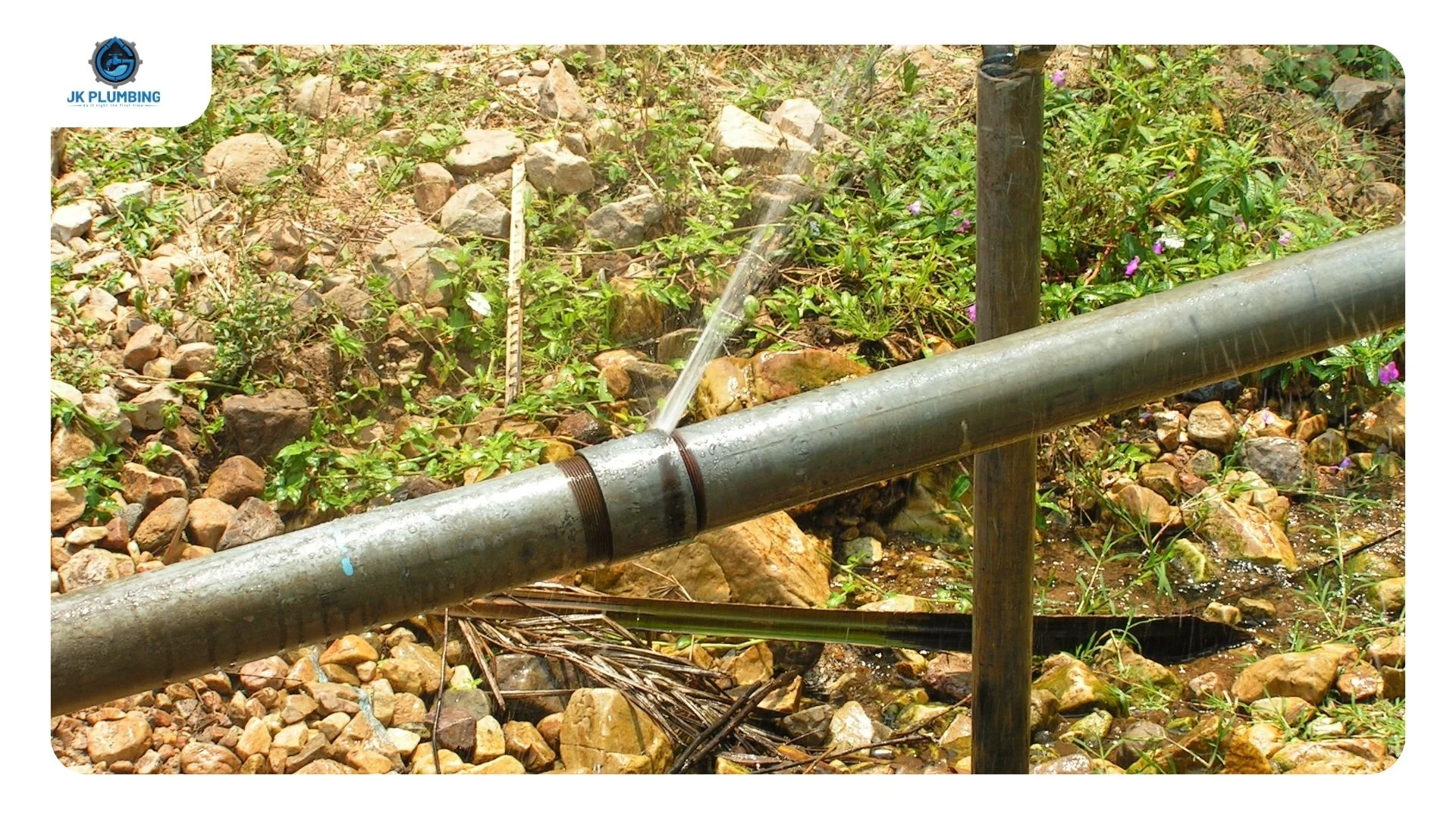
Trenchless versus open-cut: what each actually involves
Pipe bursting pulls a bursting head through the old pipe, fracturing it outward into the surrounding soil while drawing a new HDPE pipe in behind it. You get a full-diameter new pipe — sometimes larger than the original — with no joints along the run. It needs both pits and reasonably cooperative soil, and it won’t work where the old pipe has collapsed badly enough that the head can’t be pulled through.
CIPP lining (cured-in-place pipe) inserts a resin-saturated liner into the existing pipe and cures it in place, forming a new pipe inside the old one. Minimal or no excavation, but it has real limits: the host pipe has to be structurally continuous, significant offsets or a collapse rule it out, the liner costs you a small amount of internal diameter, and every branch connection has to be reinstated after curing.
Open-cut removes and replaces the pipe outright. It is still the right answer more often than trenchless marketing admits — where the pipe has collapsed, where the line has severe belly or grade problems that need correcting, where the route has to change, or where the run is short enough that the pits for trenchless would be most of the trench anyway.
What decides it is the camera survey, not a preference. A pipe with root intrusion and cracked joints but intact alignment is a good trenchless candidate. A pipe with a sagging section holding standing water needs the grade fixed, and no liner fixes grade.
In San Francisco you own the entire lateral — and that shapes the permit
This is the part that surprises most property owners here, and it’s where San Francisco differs from a lot of the Bay Area.
Per the SFPUC, the sewer main belongs to the City, but the entire sewer lateral belongs to the property owner — upper lateral, lower lateral, vent and trap, all the way to the connection at the main. There is no point on the run where it becomes the City’s pipe. In parts of the East Bay, owner responsibility stops at the property line. Here it doesn’t.
That ownership drives which permit the job needs, and there are two different ones:
- A Side Sewer Permit, from SF Public Works, covers lateral work in the public right-of-way — from the property’s sewer trap out to the City main in the street.
- A General Excavation Permit covers the work between the building and the trap.
A few practical consequences that affect scheduling and who’s on site:
- The permittee has to have a certificate of liability insurance on file with Public Works Permits before the permit issues.
- Pavement and sidewalk cutting, excavation, backfill and restoration in the right-of-way must be done by a licensed paving contractor to Public Works standards. On an open-cut job reaching the street, that means a paving contractor as well as a plumbing crew — which is a real part of the timeline, not an afterthought.
- New laterals over the standard 6-inch diameter can require a referral and written approval from the SFPUC before the permit application moves forward.
Anyone quoting you lateral work in the right-of-way without mentioning permits or restoration is quoting you an incomplete job. Who pays for sewer lateral replacement in San Francisco goes further into the responsibility question.
What happens when two buildings share one lateral?
Shared laterals are common in San Francisco, usually a legacy of a single lot that was later split, or of two buildings put up together and plumbed together. If yours is shared, you’ll typically find it out during a camera survey when the line picks up flow from somewhere you can’t account for.
The process side. The shared segment serves both properties, so work on it affects both. In practice that means agreeing access, agreeing timing, and giving the neighbouring building notice of a service interruption — all before anything is scheduled. If the shared segment runs beneath one owner’s property, the other owner needs permission to get to it. Where there’s an easement on title it’s straightforward. Where there isn’t, it’s a conversation, and occasionally a legal one.
The cost side. There’s no City mechanism that compels a neighbour to contribute. The shared pipe is private property, cost-sharing is a private arrangement between owners, and if your neighbour declines you’re left choosing between paying for the whole repair or separating your lateral entirely — running a new, independent line to the main. Separating costs more upfront and permanently ends the problem. We’ve seen both decisions make sense.
What we’d recommend in every shared-lateral case: get the camera survey done and the line located properly first, so both owners are looking at the same evidence rather than arguing from guesses. It changes the tone of the conversation considerably.
Can you use the plumbing while the work is going on?
Partly, and with planning.
Water stays on throughout. What’s interrupted is drainage, and only during specific phases:
- Open-cut: the lateral is out of service while the pipe is cut out and the new section tied in. On most single-run residential jobs that’s within a working day.
- Pipe bursting: drainage is down on the day of the burst and tie-in, usually a shorter window than open-cut.
- CIPP lining: out of service during the liner installation and cure — typically hours rather than a day.
We tell you the night before which day is the no-drainage day so you can plan around it. For multi-unit buildings, that notice needs to reach every unit, and that’s worth coordinating with us rather than leaving to the morning of.
How we confirm the problem before recommending replacement
We won’t quote a lateral replacement off a blocked drain. Repeated backups have plenty of causes that aren’t a failed pipe, and replacing a lateral that didn’t need replacing is an expensive way to find that out.
What we do first:
- Clear the line enough to see it. A camera can’t survey a pipe full of standing water or debris, so cabling or hydro jetting often comes before the camera.
- Camera survey the full run, building to main, with the footage recorded. You get to watch it. If someone tells you a pipe is failed without showing you, ask why.
- Locate and depth the defect using a sonde, so we know exactly where the problem sits, how deep, and what’s above it — driveway, garden, sidewalk, street.
- Identify whether the lateral is shared, which the survey usually reveals.
- Then recommend — and that recommendation is sometimes a spot repair, a cleanout installation, or jetting on a schedule rather than a full replacement.
If you don’t have a usable access point, that’s its own fix first. Sewer cleanout installation covers that, and main sewer line cleaning covers the maintenance route where the pipe is sound.
Where we do lateral work in San Francisco
We work across the city, including the conditions that make SF laterals awkward — buildings sitting lot-line to lot-line with no side access, laterals running under garage slabs and light wells, front steps directly over the run, and the steep grades through Bernal Heights, Potrero Hill, Noe Valley and Glen Park where any open excavation needs proper shoring.
Also the Sunset, the Richmond, the Mission, the Excelsior, and down the Peninsula through Daly City, Brisbane, South San Francisco and Burlingame. Our lateral sewer line replacement page covers the service itself.
Frequently asked questions
Will you need to dig up the driveway, garden or street?
Less than with a full trench, but no method is completely dig-free. Pipe bursting needs an access pit at each end of the run and leaves everything between them untouched. CIPP lining can sometimes work through existing access points with no new excavation. Open-cut opens the full length. Because San Francisco laterals run to the main under the street, a defect in the lower section means opening something at that end whichever method is used.
What is the difference between trenchless and open-cut replacement?
Open-cut trenches the pipe’s length and replaces it outright. Trenchless works through small access pits: pipe bursting fractures the old pipe outward and pulls a new HDPE pipe through behind it, while CIPP lining cures a resin liner inside the existing pipe. Trenchless preserves surfaces but needs the old pipe to be intact enough to work with, and no liner can correct a sagging grade.
Our building shares a lateral with next door — how does that work?
Both properties rely on the shared segment, so access, timing and service interruption have to be agreed between owners before scheduling. Cost-sharing is a private arrangement — San Francisco has no mechanism to require a neighbour to contribute. If agreement isn’t possible, separating your lateral with an independent run to the main costs more upfront and permanently removes the shared dependency.
Can we use the plumbing while the work is going on?
Water stays on throughout; drainage is interrupted only during specific phases. Open-cut takes the lateral out of service while the pipe is cut out and tied in, usually within a working day. Pipe bursting interrupts drainage on the burst and tie-in day. CIPP lining is out of service during installation and curing, typically hours. We give notice the night before the no-drainage day.
How do you confirm the problem before committing to replacement?
We clear the line enough to see it, run a recorded camera survey from the building to the main, locate and depth the defect with a sonde so we know what sits above it, and check whether the lateral is shared. Only then do we recommend — and the recommendation is often a spot repair, a cleanout, or scheduled jetting rather than a full replacement. You see the footage either way.
Visit or Call Us
JK Plumbing
Adress:1008 Edwards Rd Burlingame, CA 94010
Phone: (415) 359-4588
Hours: Monday–Saturday, open 24 hours. Closed Sunday.
Serving San Francisco and the Peninsula, including Bernal Heights, Noe Valley, Potrero Hill, the Mission, the Sunset, the Richmond, and Daly City.
CA License #1080266
RECENT POSTS
Hot Water Heater Replacement in San Francisco: Tank, Tankless or Upgrade?
October 29, 2026
No Comments
Read More »
Water Heater Replacement Near Me: San Francisco and Pacifica
October 28, 2026
No Comments
Read More »