
- Open 24 Hours Mon–Sat
- contact@jkplumbingsf.com
- +1 (415) 359-4588
- CA License #1080266

Where to install a water heater in a South San Francisco home comes down to three spots: the attached garage, a dedicated utility closet, or an exterior enclosure. Which one is legal for your house depends on fuel type, combustion air, clearances, and vehicle protection.
JK Plumbing handles these placements across South San Francisco daily. Call (415) 359-4588.
By Alik, Owner & Master Plumber · Last updated October 2026
Garages: the 18-inch rule, and why it often doesn’t apply anymore
This is the single most misunderstood rule we deal with.
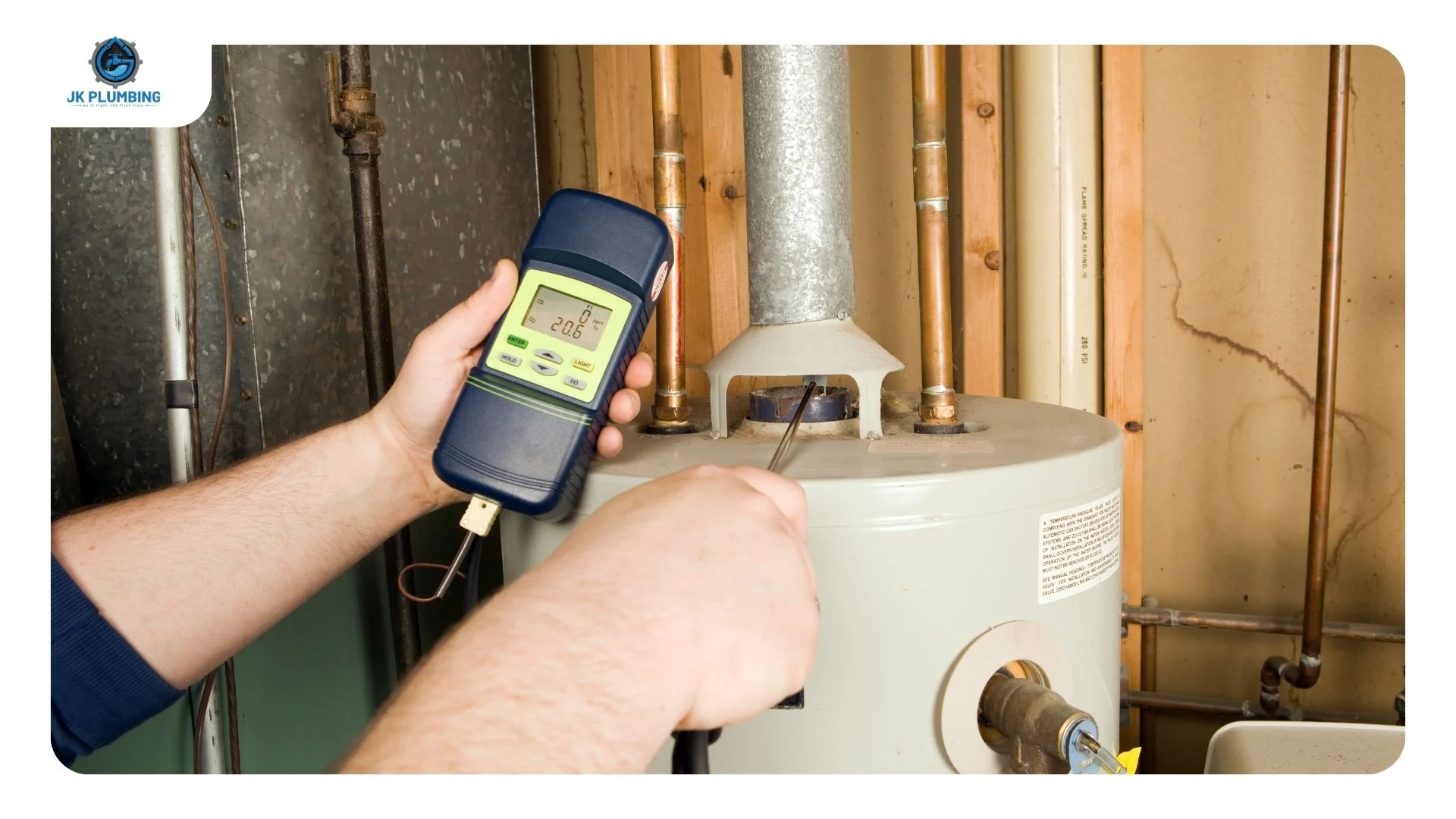
California Plumbing Code 507.13 says appliances in garages have to be installed so burners and ignition devices sit at least 18 inches above the floor — the point being that gasoline vapor pools low, and you don’t want an ignition source down in it. That’s the rule people remember, and it’s why you see so many older units perched on a platform.
What most people don’t know: the same code section exempts units listed as Flammable Vapor Ignition Resistant. FVIR technology has been standard on 30, 40, and 50-gallon residential gas water heaters sold in the US since July 2003, because the unit is engineered to handle a floor-level vapor on its own. An FVIR-listed heater can generally sit directly on the garage floor.
Two caveats we’d rather you hear from us than discover at inspection:
- Local inspectors vary. Some jurisdictions still expect the platform regardless. We confirm the city’s current position before we set the unit, not after.
- The elevation exemption is not an exemption from impact protection. CPC 507.13.1 requires the appliance to be located or protected so a moving vehicle can’t damage it. That means a bollard or barrier if it sits in the path of a car. This matters more in South San Francisco than in a lot of our service area — garages here are genuinely used for parking, and in the tighter Westborough and Serra Highlands garages the heater is often right where a bumper ends up.
Electric units don’t have a burner, so the elevation question doesn’t arise. Impact protection still does.
Utility closets and tight interior spaces
A closet is a legal location for a water heater. It just stops being a simple one the moment the unit burns gas.
Combustion air is the constraint. A gas water heater in a confined space needs two openings — one within 12 inches of the top of the enclosure, one within 12 inches of the bottom — sized per CPC 506. Local guidance commonly puts that at 100 square inches each for a typical residential unit. A closet with a solid door and no vents is not a legal gas installation, no matter how long the old unit has been in there.
Bedrooms and bathrooms are restricted. A gas water heater generally can’t be installed in a bedroom or bathroom unless it’s a sealed-combustion direct-vent model, or it sits in a closet with a listed self-closing door drawing its combustion air from outside the room. That closet also can’t double as storage.
Electric and heat pump units change the math — no combustion air requirement at all. For genuinely tight interior spaces, an electric unit is often the only thing that fits the rules, though a heat pump has its own space problem (below).
Attics and under-floor spaces are permitted but rarely pleasant. You need a proper access opening and passageway, a level working platform in front of the unit, and a drain pan plumbed to an approved location. We’ll do it. We’ll also tell you honestly that servicing a heater up there costs more every single time for the life of the unit.
Seismic strapping, pans, and the code items tied to placement
Yes — every water heater in California needs seismic strapping, on every install, in every location. This isn’t optional and it isn’t regional.
- Two straps, one in the upper third of the tank and one in the lower third, with the bottom strap at least four inches above the controls, per CPC 507.2. California Health and Safety Code 19211 requires water heaters to be braced or anchored against earthquake displacement generally.
- This is not a formality here. The San Andreas fault runs along the reservoir chain immediately west of South San Francisco — under a mile from parts of Westborough.
- A drain pan where a leak could cause damage — attics, upper floors, over finished space. At least 1.5 inches deep with a drain run to an approved location, per CPC 507.5. In a garage with a floor drain, a pan often isn’t required, though we frequently install one anyway.
- T&P discharge piping run full-size to an approved point, terminating 6 to 24 inches above grade, with no threads on the end.
- Pipe insulation on the first five feet of hot and cold lines.
- Exterior installs need a level slab at least 3 inches above grade inside an approved enclosure.
Heat pump units: placement is the entire decision
If you’re considering a heat pump water heater — and with the Bay Area zero-NOx rule approaching, more South San Francisco homeowners are — placement stops being a detail and becomes the whole conversation.
A heat pump unit pulls heat from the air around it. It needs real air volume, typically several hundred cubic feet, or ducting to compensate. It needs a condensate drain. It needs a 240V circuit. It’s taller than the gas tank it replaces. And it cools and dehumidifies whatever space it’s in, which is fine in a garage and unwelcome in an interior closet off a hallway.
This is where South San Francisco’s housing stock is an advantage. The post-war tract homes through Sunshine Gardens, Winston Manor, and Buri Buri nearly all have attached garages with the water heater already standing in open air — close to ideal. The constraint in those homes is usually the electrical panel, not the room, since many are still on original service. We check panel capacity on the first visit.
The homes where this gets hard are the smaller Old Town places and condo or townhouse utility closets, where the honest answer is sometimes that a heat pump won’t fit without construction. We’d rather say that upfront. Our heat pump water heater page covers what those installs involve, and when to replace a water heater in South San Francisco covers sizing and timing.
Can a water heater be moved to a better spot?
Often, yes — and a replacement is the natural moment to do it, because the unit is already coming out. Relocating means extending or rerouting water lines, gas line if applicable, venting, and the T&P discharge, plus a permit covering the new location. Moving a heater out of a cramped hallway closet into the garage is one of the more satisfying jobs we do, and it usually makes every future service call cheaper.
What we’d push back on: moving a unit into a space that barely meets clearances just to free up storage. Code minimums are minimums, not targets.
Where we work in South San Francisco
We handle water heater placements across the city — Sunshine Gardens, Buri Buri, Westborough, Avalon-Brentwood, Winston Manor, Serra Highlands, Paradise Valley, Mayfair, Old Town, Orange Park, and the Sign Hill side — plus San Bruno, Millbrae, Colma, Brisbane, Daly City, Burlingame, and Hillsborough.
Frequently asked questions
Does a new water heater need seismic strapping?
Yes, always, in every California installation. Two straps — one in the upper third of the tank, one in the lower third, with the bottom strap at least four inches above the controls, per California Plumbing Code 507.2. We fit them on every install and the inspector checks them.
Do you fit a new drain pan as well?
Where one is required — attics, upper floors, anywhere a leak would damage finished space — yes, at least 1.5 inches deep and plumbed to an approved drain. In a garage with a floor drain a pan often isn’t required by code, but we’ll usually recommend one anyway. It’s cheap insurance against a slow seam leak.
Can you install in a garage, closet, or tight space?
Yes to all three, within what code allows. Garages are the simplest. Closets work for gas units only with proper combustion air openings top and bottom, and are straightforward for electric. Genuinely tight spaces sometimes point toward an electric or tankless unit rather than a tank. We measure and tell you what actually fits before you buy anything.
Do you handle the gas and water connections as part of the install?
Yes. Water supply connections, gas line connection with an earthquake-rated flex connector, venting, and T&P discharge piping are all part of the job, along with any rerouting needed if the unit is moving. There’s no separate trade to coordinate.
Are you a bonded and insured plumbing contractor?
Yes. JK Plumbing holds CA Contractor’s License #1080266, active since 2007, and carries general liability and workers’ compensation coverage. You can verify the license on the CSLB website, and we send certificates of insurance to HOAs or property managers on request.
Visit or Call Us
JK Plumbing
Adress:1008 Edwards Rd Burlingame, CA 94010
Phone: (415) 359-4588
Hours: Monday–Saturday, open 24 hours. Closed Sunday.
CA License #1080266
Serving South San Francisco and the surrounding Peninsula, including Sunshine Gardens, Buri Buri, Westborough, Avalon-Brentwood, San Bruno, and Millbrae.
RECENT POSTS
Where to Install a Water Heater in a South San Francisco Home: What’s Allowed?
October 12, 2026
No Comments
Read More »
Who Can Change a Water Heater Quickly in South San Francisco?
October 9, 2026
No Comments
Read More »