- Open 24 Hours Mon–Sat
- contact@jkplumbingsf.com
- +1 (415) 359-4588
- CA License #1080266

Most people choose the unit first and look at everything else afterwards. That’s backwards, and it’s the sequence that costs money — rebates have conditions you can fail by buying too early, and a panel that can’t carry a heat pump rules out an option before you’ve compared anything. JK Plumbing is based in Burlingame, next door. Call (415) 359-4588.
By Alik, Owner & Master Plumber · Last updated October 2026
Step one: confirm it’s actually time to replace
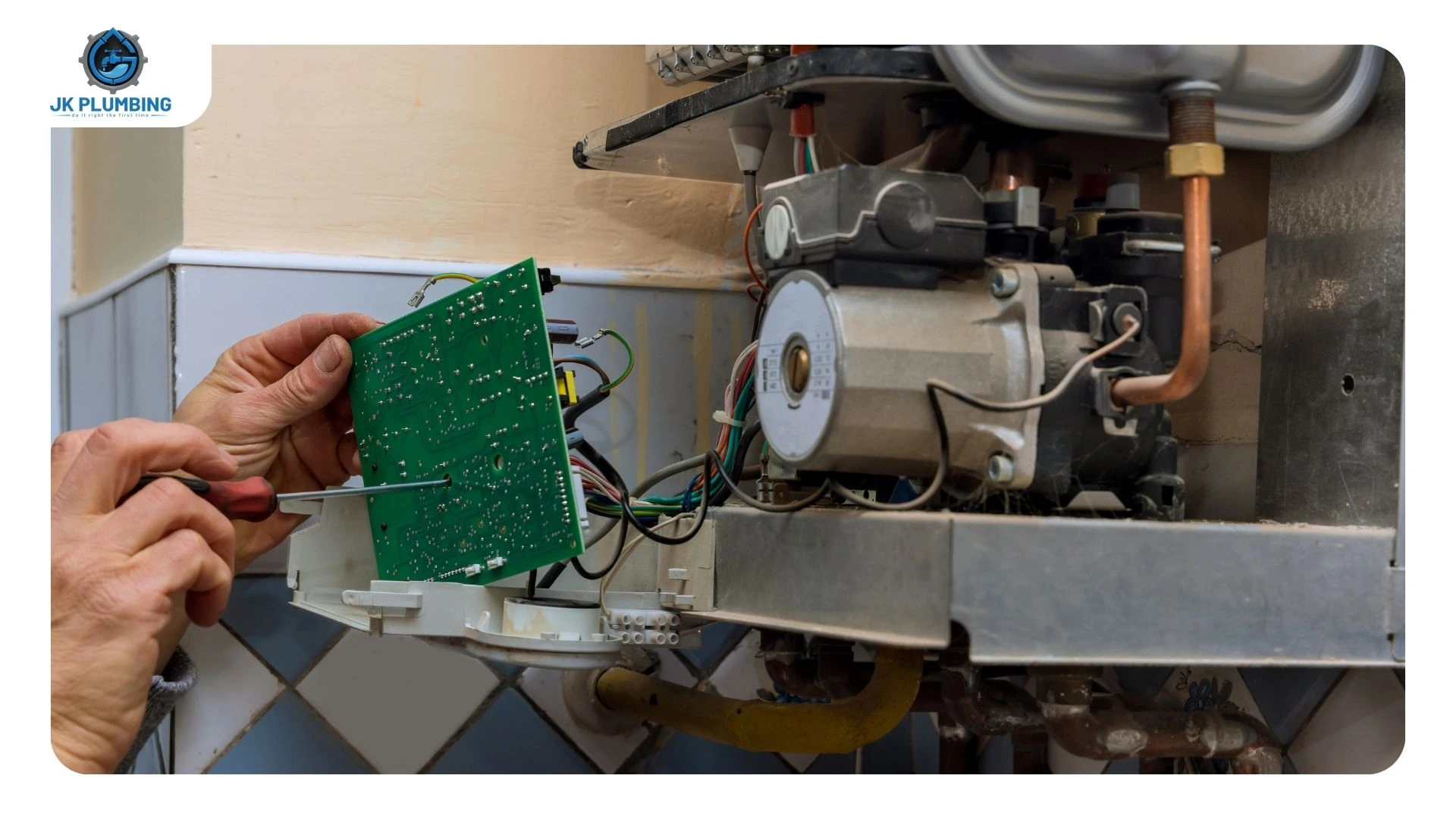
A standard tank lasts eight to twelve years, a heat pump unit twelve to fifteen, a well-maintained tankless fifteen to twenty. But age alone doesn’t decide it.
Replace when the tank itself has failed: rust-coloured hot water from the hot side only, water emerging from the tank seam or body, or a tank that rumbles again within a year of being flushed.
Repair when the fault is external and the unit is reasonably young: thermocouples, elements, thermostats, dip tubes and relief valves are all serviceable parts. Under eight years, repairing is usually right.
It depends between eight and ten years, where the specific fault and the warranty status decide it. How to know when water heater repair is worth it covers that properly, and what each symptom means separates the repairable faults from the terminal ones.
Don’t skip this step because the unit is old. We’ve replaced plenty of twelve-year-old tanks that needed replacing, and we’ve also fixed a few with a twenty-dollar part.
Step two: check the panel before you compare units
This is the step that silently removes an option, and almost nobody does it first.
A heat pump water heater needs a 240V circuit. Plenty of San Mateo’s post-war housing — much of Shoreview, Sunnybrae and the Laurelwood tracts — is still on its original electrical service, and a panel at capacity means a panel upgrade before a heat pump is possible at all.
That doesn’t rule heat pumps out. It changes the budget and the timeline, and it needs to be known at the start rather than discovered after you’ve decided. A panel upgrade is also its own scheduling item, not something bolted onto an install day.
Two other physical checks worth doing at the same time: whether the space has the air volume a heat pump needs, and whether there’s a condensate drain within reach. A garage usually has both. A tight interior closet in a Hillsdale townhouse often has neither.
Step three: check the rebate rules before you buy anything
San Mateo is in San Mateo County, which means Peninsula Clean Energy, not the programmes you’ll read about for Palo Alto or further south.
As of PCE’s May 2026 terms, replacing a gas, propane or oil water heater with a heat pump unit qualifies for a $3,500 rebate, with a separate rebate toward a panel upgrade and BayREN money layerable on top. PCE also runs a zero-interest loan programme for San Mateo County homeowners.
The sequencing is the part that catches people out. Rebate programmes typically have conditions attached to how the work is done, not just what gets installed — things like using a licensed contractor, supplying documentation that the old unit was decommissioned, and sometimes establishing eligibility before the work rather than after. Buy a unit, have it fitted by whoever’s cheapest, and then go looking for the rebate, and you can find you’ve disqualified yourself from several thousand dollars.
We check current programme terms before quoting, because they change and because the rebate often moves the net cost more than the choice between two units does. Confirm what’s current when you start — don’t rely on a figure you read months ago, including this one.
Step four: then choose tank, tankless or heat pump
With the panel and rebate position known, the comparison is a real one.
Gas tank. Cheapest to install, simplest to replace, slowest to improve your bills. The right answer when the existing setup is sound, the budget is tight, or access is difficult. Worth knowing that the Bay Area Air District’s zero-NOx standard for new residential water heaters is currently set for January 2027, with amendments under consideration that would move it to 2028 — so the window for a straightforward gas tank replacement is a live question rather than an open-ended one.
Tankless. Endless hot water, recovers floor space, and performs well on San Mateo’s water, which comes largely from the soft SFPUC regional supply. The cost sits in the infrastructure: gas line upsizing to feed 150,000 to 199,000 BTU, new sealed venting, condensate drainage. Tank, tankless or upgrade goes through that comparison in detail.
Heat pump. The largest reduction in energy use — roughly three to four units of heat per unit of electricity — and where the rebate money is. Needs the panel, the space and the condensate drain from step two. Our heat pump water heater page covers what those installs involve.
Step five: size it
Sizing comes last because the right size depends on which type you’ve chosen.
For a gas tank, a three-bedroom house or a family of four generally lands on a 50-gallon unit. One to two people suit 30 to 40 gallons; five or more, or two-plus full bathrooms, want 50 to 75. Check first-hour rating rather than gallons alone — two 50-gallon heaters can differ by 20 gallons in what they actually deliver in a busy hour.
For a heat pump, size up one step from the gas equivalent. Recovery is slower, so a household comfortable on a 50-gallon gas tank usually wants a 65 or 80-gallon heat pump unit. Swapping like-for-like on gallons is the most common sizing mistake on electrification jobs.
For tankless, size by flow rate rather than capacity. A shower uses roughly 1.8 to 2.5 gallons per minute. Two simultaneous showers is about 5 gpm, which at the mid-Peninsula’s typical temperature rise means a unit at the top of the residential range.
What it costs in San Mateo
We quote in writing after seeing the installation, not over the phone, because the variation is in the existing setup rather than the unit.
What moves the number: the unit type and capacity, code items the current installation is missing (seismic strapping, expansion tank, drain pan, earthquake-rated gas connector), venting changes, electrical work on a heat pump conversion, gas line upsizing on a tankless conversion, the permit through the City of San Mateo, and access to wherever the unit sits.
And rebates, which on a heat pump conversion frequently change the net figure more than any of the above.
Where we work
San Mateo — Baywood, San Mateo Park, Hillsdale, Shoreview, Sunnybrae, Laurelwood and Bay Meadows — plus Burlingame, Millbrae, Foster City, San Carlos, Belmont and north through the Peninsula to South San Francisco and San Francisco.
Our water heater replacement page covers the service itself.
Frequently asked questions
How do I know it is time to replace rather than repair?
Replace when the tank itself has failed — rust-coloured hot water on the hot side only, water from the tank seam or body, or rumbling that returns within a year of a flush. Repair when the fault is an external component and the unit is under eight years old. Between eight and ten, the specific fault and the warranty status decide it.
How much does water heater replacement cost in San Mateo, CA?
It depends on the unit type and capacity, what code items the existing installation lacks, venting changes, electrical work for a heat pump, gas line upsizing for tankless, the City of San Mateo permit, and access. We quote in writing on site. Rebates often shift the net cost of a heat pump conversion more than any single line item.
What size unit does my household actually need?
For a gas tank, a three-bedroom home or family of four usually needs 50 gallons; one to two people, 30 to 40; five or more or two-plus bathrooms, 50 to 75. Check first-hour rating rather than gallons alone. For a heat pump, size up one step because recovery is slower. For tankless, size by flow rate — about 5 gallons per minute covers two simultaneous showers.
Tank, tankless or heat pump: which fits my home?
Gas tank is cheapest and simplest but improves bills least, and the Bay Area zero-NOx standard makes its long-term availability a live question. Tankless performs well on San Mateo’s soft water and recovers space, with the cost sitting in gas line and venting work. Heat pump cuts energy use most and carries the rebates, but needs panel capacity, air volume and a condensate drain — which is why those get checked first.
Are there rebates for a high-efficiency replacement in California?
In San Mateo County, through Peninsula Clean Energy — as of its May 2026 terms, $3,500 toward a heat pump water heater replacing gas, plus a panel upgrade rebate, BayREN money and a zero-interest loan programme. Critically, programmes have conditions about how the work is done and documented, so establish eligibility before buying rather than after. Terms change; confirm what’s current when you start.
Visit or Call Us
JK Plumbing
Adress:1008 Edwards Rd Burlingame, CA 94010
Phone: (415) 359-4588
Hours: Open 24 hours, seven days a week.
Serving San Francisco, South San Francisco, Daly City, Brisbane and the Peninsula.
CA License #1080266
RECENT POSTS
Water Heater Replacement in San Mateo: Do These in the Right Order
November 2, 2026
No Comments
Read More »