- Open 24 Hours Mon–Sat
- contact@jkplumbingsf.com
- +1 (415) 359-4588
- CA License #1080266

Adding an exterior sewer cleanout in San Francisco typically runs from around $900 for a shallow tie-in through soft ground to $3,500 or more where the line is deep or sits under concrete. It’s one of the few plumbing investments that pays for itself, because every future service call on your sewer line gets faster and cheaper once the access exists.
By Alik, Owner & Master Plumber · Last updated September 2026
What is a sewer cleanout, and why would you need one?
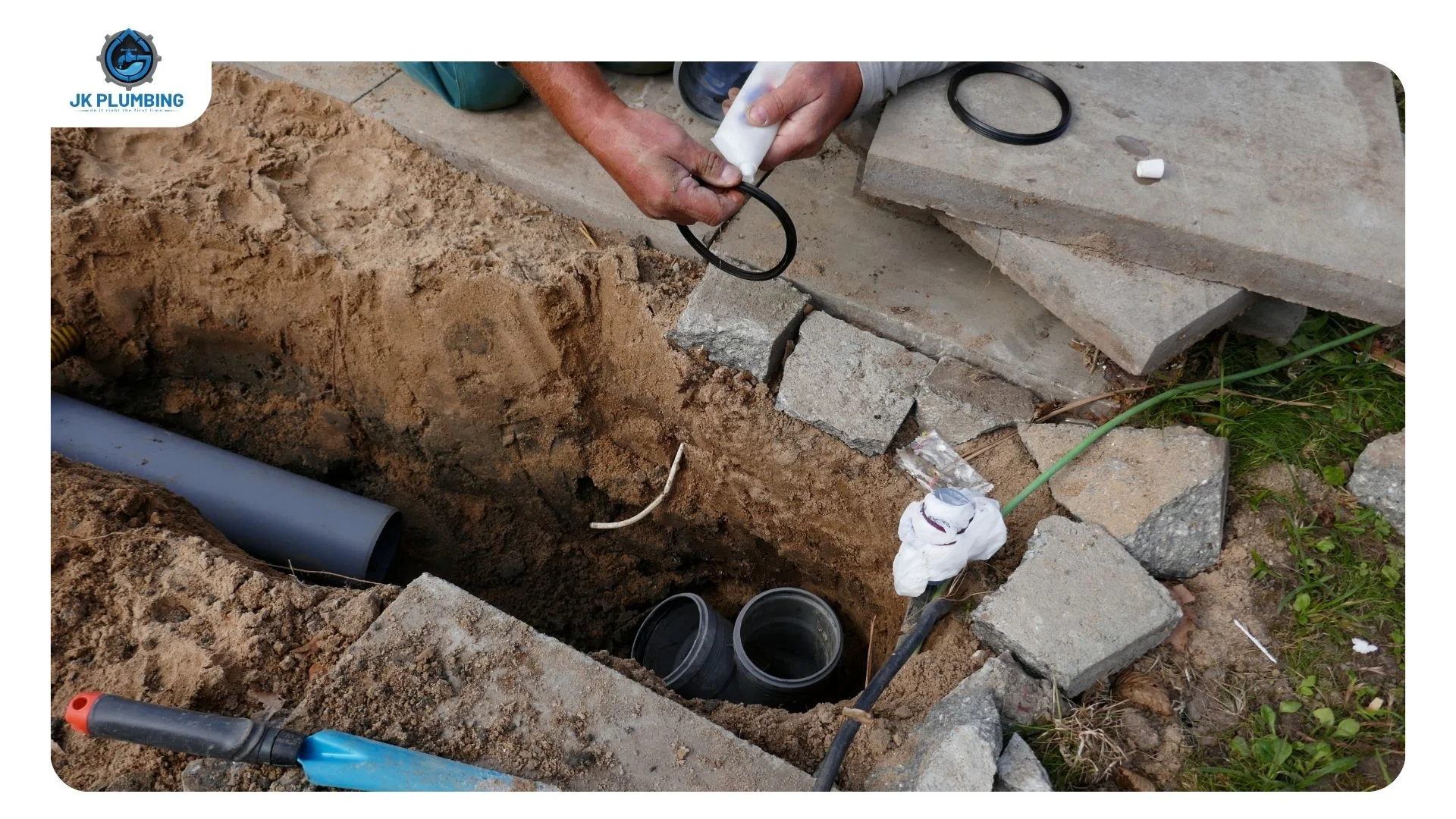
A cleanout is a capped access point tied into your sewer line — usually a 3- or 4-inch pipe with a threaded plug, either standing a few inches above grade or set flush under a small lid. It isn’t a drain. Nothing goes into it. Its only job is to give a plumber a direct, straight-line entry into the pipe.
That matters more than it sounds like it should. Without a cleanout, clearing a main line means going in through a pulled toilet or down a roof vent. Both work. Both are slower, messier, and put the cable or jetter hose through bends it wasn’t designed to negotiate, which limits how far it reaches and how well it cuts.
A cleanout also does something a roof vent can’t: it gives a backed-up line somewhere to overflow outside the building. When the main blocks and pressure builds, water finds the lowest opening. If that opening is an exterior cleanout cap in the side yard, you get a mess on the concrete. If it’s a ground-floor shower pan or a garage floor drain, you get sewage inside the house. For a San Francisco property with finished space at ground level — which is most of them — that difference is the whole argument.
What drives cleanout installation cost in San Francisco?
Depth of the line. A lateral running three feet down is a different excavation than one running seven feet down on a sloped Bernal Heights lot.
What’s on top of it. Soft ground in a side yard is the cheap version. Cutting and patching a concrete driveway, a garage slab, or a paved light well is where the number climbs — and in San Francisco, where front setbacks are narrow and a great many properties paved over whatever yard they had, this is the common case rather than the exception.
Pipe material at the tie-in point. Cutting into ABS or PVC is straightforward. Tying into brittle vitrified clay or corroded cast iron means working carefully around a pipe that can crack when disturbed, and occasionally replacing a short section to get a sound connection.
Where it lands relative to the property line. Work on your side of the trap is a DBI plumbing permit. Work extending past the trap toward the main is a San Francisco Public Works Side Sewer permit, which carries a $25,000 street excavation bond requirement and a separate contractor license standard. Those are different jobs with different price floors.
Call (415) 359-4588 and describe the property — in most cases we can tell you over the phone which of those situations you’re likely in.
Where should a sewer cleanout be located?
The California Plumbing Code sets the requirements in Section 719.0 of current editions — older editions numbered it 707, which is why a lot of contractor websites still cite the wrong section. The requirements themselves have been stable for decades:
- A cleanout at the upper terminal of each horizontal drainage run.
- A cleanout every 100 feet of developed length.
- An additional cleanout for each aggregate horizontal change of direction exceeding 135 degrees.
- Clearance in front of the cleanout — not less than 12 inches on piping 2 inches and under, and 18 inches on anything larger. A 4-inch main line cleanout needs that 18 inches of working space, which is exactly why a cleanout buried under a deck, boxed into a cabinet, or paved over is treated as no cleanout at all.
- Cleanouts in under-floor piping must be extended to or above the finished floor, or outside the building, where there’s less than 18 inches of vertical clearance and 30 inches of horizontal clearance from the access point.
That last one is worth reading twice if you own a San Francisco house with a shallow crawlspace. A cleanout technically exists down there in a lot of these properties, but if a plumber can’t physically reach it and operate equipment, the code says it needs to come out to grade.
In practice, the location you want is at or near where the building drain leaves the house and becomes the building sewer — close to the foundation, outside, at grade.
No accessible cleanout? What San Francisco properties actually do
This is the single most common situation we find in this city, and it comes from four directions:
The house predates the requirement. A great deal of San Francisco’s housing stock went up before exterior cleanouts were standard practice. There’s nothing to find because nothing was installed.
It was paved over. Garage conversions, driveway pours, patio work, and light-well concrete have buried thousands of cleanouts in this city. The fitting is still down there, six inches under a slab.
It’s in the crawlspace and unreachable. Common in Sunset and Richmond houses — the access exists, but not with the clearance the code requires or a jetter hose needs.
There’s an old building trap in the way. Many older San Francisco homes have a house trap on the lateral, sometimes with a fresh air inlet at the foundation. These affect how the line can be accessed and cleared, and how a new cleanout should be positioned relative to them.
The fix in each case is the same in principle: locate the line with a camera and a pipe locator, then tie a new cleanout into it at a workable spot and bring the riser to grade. That’s a permitted job, not a re-pipe, and it’s typically a one-day excavation.
If you’ve had a main line cleared through a pulled toilet or a roof vent — see our guide to main sewer line cleaning for why that costs more — you’re paying a surcharge on every single service call that a one-time installation removes permanently.
Two-way cleanouts, and why they’re worth the small difference
A standard cleanout gives access in one direction. A two-way cleanout uses a fitting that opens access both toward the house and toward the street, from a single access point.
The code explicitly allows this: an approved two-way cleanout fitting installed inside the building wall near the junction of the building drain and building sewer — or outside at the lower end of the building drain, extended to grade — is permitted as a substitute for an upper terminal cleanout.
The practical value is diagnostic. When a line backs up, the first question is whether the blockage is between the house and the cleanout or between the cleanout and the city main. With a two-way fitting, a plumber answers that in minutes by running the camera each direction from one hole. In San Francisco that question has real money attached to it, because the lower lateral beyond the curb is handled by SFPUC in most circumstances rather than by you.
The incremental cost over a single-direction cleanout is small. The excavation — the expensive part — is identical. We specify two-way as the default unless there’s a reason not to.
Does adding a cleanout make future servicing cheaper?
Yes, and measurably. Three ways:
Faster access. No pulling and resetting a toilet, no ladder work at the roof, no protecting interior finishes. That’s labor off every future invoice.
Better results. Equipment entering through a straight, full-diameter opening near the foundation reaches further and cuts better than the same equipment fed through a toilet flange or down a 2-inch vent stack with bends in it. Some jetting work simply isn’t practical without proper access.
Cheaper diagnostics. A camera survey through a cleanout is routine. Without one, the survey costs more and covers less — which matters if you’re ever selling, since sewer camera inspections have become a normal part of the buyer’s inspection.
For a property with mature street trees over the lateral, or a cast iron line that’s already scaled, the cleanout usually pays for itself across two or three service calls.
Can a cleanout be added during other sewer work?
Yes — and that’s by far the cheapest time to do it, because the excavation is already open and already paid for.
If you’re having a lateral replacement, a spot repair, a trenchless lining, or any job that opens ground over the line, adding a cleanout is a modest line item rather than a standalone project. Code generally requires cleanouts as part of permitted sewer replacement work anyway, so on a full lateral job it’s usually not optional.
Ask about it explicitly when you get a quote for any sewer work. If the scope doesn’t include bringing a code-compliant cleanout to grade, that’s a question worth raising before the trench is backfilled, not after.
Where we work in San Francisco and on the Peninsula
We install sewer cleanouts across San Francisco — the Sunset, Inner and Outer Richmond, Noe Valley, Bernal Heights, Glen Park, Potrero Hill, the Mission, the Excelsior, and West Portal — plus Daly City, South San Francisco, Burlingame, and San Mateo.
Related reading: main sewer line cleaning costs in San Francisco and our hydro jet drain cleaning and drain cleaning service pages.
Sewer cleanout FAQ
How much does sewer cleanout installation cost in San Francisco?
As of September 2026, expect roughly $900 for a shallow tie-in through soft ground, rising to $3,500 or more where the line runs deep or sits under a concrete driveway, garage slab, or paved light well. Depth, surface restoration, and the condition of the pipe at the tie-in point are the main drivers. Work extending past the trap toward the city main falls under a different permit and prices differently.
What is a sewer cleanout and why would I need one?
A cleanout is a capped access point tied into your sewer line, giving a plumber direct entry for cabling, jetting, and camera work. Without one, main line service has to go through a pulled toilet or a roof vent, which is slower and less effective. A cleanout also gives a backed-up line somewhere to overflow outside the building rather than through the lowest drain inside it.
My property has no accessible cleanout — what are the options?
Very common in San Francisco, usually because the house predates the requirement, the cleanout was paved over during a garage conversion or driveway pour, or it sits in a crawlspace without the clearance the code requires. We locate the line with a camera and pipe locator, then tie a new cleanout in at a workable point and bring the riser to grade. It’s a permitted one-day excavation, not a re-pipe.
Does adding a cleanout make future servicing cheaper?
Yes. It removes the labor of accessing through a toilet or roof vent from every future call, lets equipment enter through a straight full-diameter opening so it reaches further and cuts better, and makes camera surveys routine rather than an add-on. On a property with mature trees over the lateral or a scaled cast iron line, it typically pays for itself within two or three service calls.
Can a cleanout be added during other sewer work?
Yes, and it’s the cheapest time to do it because the excavation is already open. On lateral replacements, spot repairs, and trenchless lining jobs, a code-compliant cleanout is usually a small line item — and on full permitted replacement work it’s generally required anyway. Ask whether it’s in the scope before the trench is backfilled.
Visit or Call Us
JK Plumbing
Adress:1008 Edwards Rd Burlingame, CA 94010
Phone: (415) 359-4588
Hours: Monday–Saturday: Open 24 hours · Sunday: Closed CA License #1080266
Serving San Francisco and surrounding areas including the Sunset, the Richmond, Noe Valley, Bernal Heights, Glen Park, Potrero Hill, and West Portal, plus Daly City, South San Francisco, Burlingame, and San Mateo.
RECENT POSTS