- Open 24 Hours Mon–Sat
- contact@jkplumbingsf.com
- +1 (415) 359-4588
- CA License #1080266

On a South San Francisco house built in the forties or fifties, the lateral is usually cast iron, vitrified clay, or bituminized fibre conduit — and which one you have decides whether the line can be lined, burst, or only dug up. JK Plumbing replaces sewer laterals across South San Francisco and San Bruno. Call (415) 359-4588.
By Alik, Owner & Master Plumber · Last updated November 2026
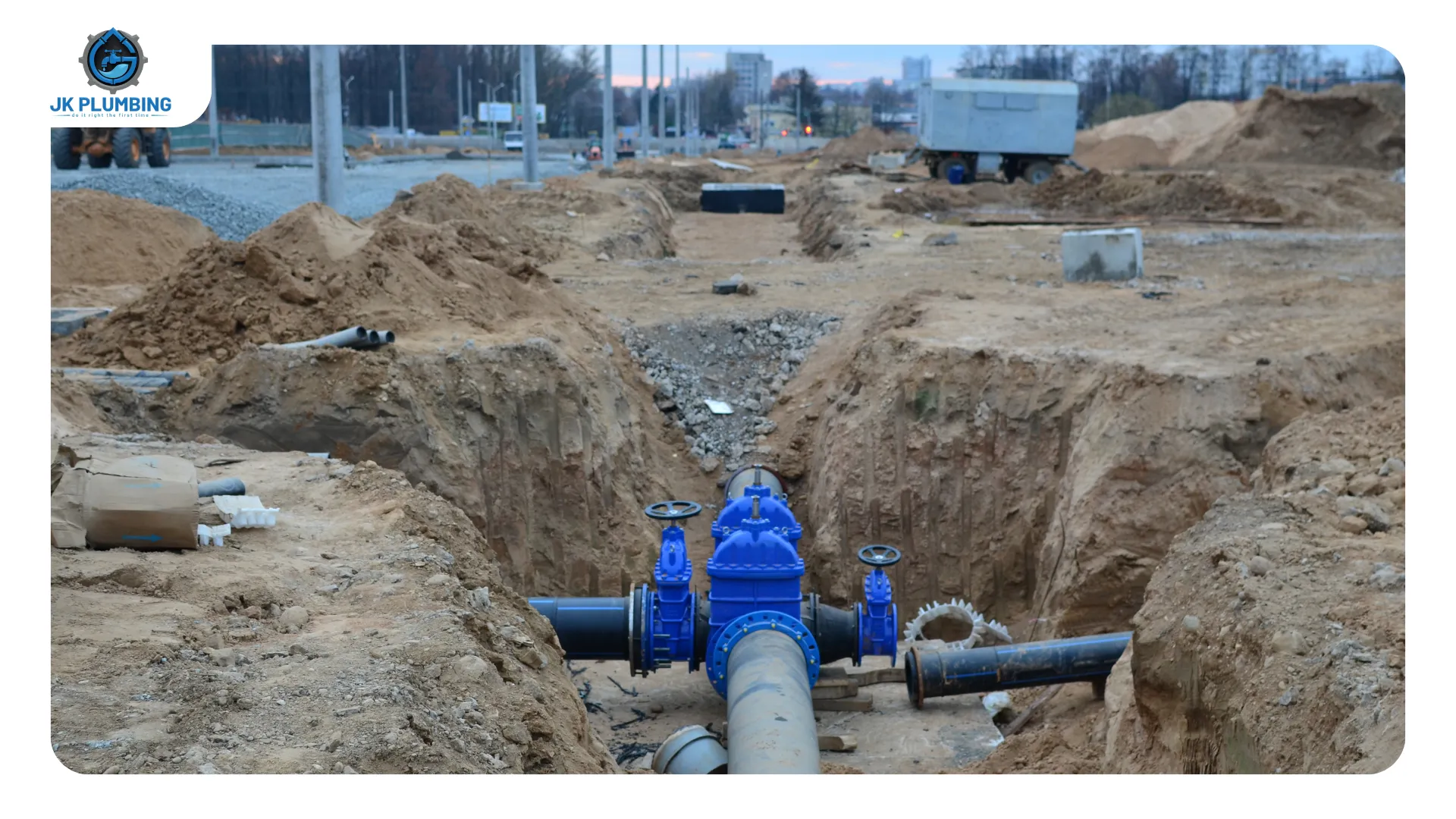
What is the lateral made of on a house built in the forties or fifties?
South San Francisco’s tract neighbourhoods went up during and after the war, which narrows the likely answer to three materials — and the third one is the one most homeowners have never heard of.
Vitrified clay. The long-serving standard. Comes in short lengths, so there’s a joint every few feet, and roots find joints. Clay cracks and offsets but it doesn’t lose its shape — which, as the next section explains, is what keeps repair options open.
Cast iron. Common on the building side and on some full laterals. It doesn’t get invaded by roots the way clay does; it corrodes from the inside. Scale builds on the pipe wall, the bore narrows, and the flow channels along the bottom until the invert rusts through. A camera in a scaled cast iron line shows a pipe that looks far smaller than its stated diameter.
Bituminized fibre conduit — Orangeburg. Wood pulp fibre bound with coal tar pitch, essentially a tarred paper tube. It was cheap, light and widely used through the post-war housing boom until PVC and ABS displaced it in the seventies. Rated for roughly fifty years in ideal ground, it has failed in considerably less, and most building codes dropped it from their accepted materials list long ago.
Orangeburg is worth identifying precisely because it fails differently from everything else. It doesn’t crack — it deforms. Under load and over time the bore goes oval, then blisters inward, then delaminates. A camera inspection shows a pipe that has lost its round cross-section. If a house in Sunshine Gardens, Avalon Park or along Sign Hill is on its original lateral, fibre conduit is a live possibility and it changes the entire conversation.
Why the material decides the method — and what a belly changes
This is the part that gets skipped, and it’s the part that determines whether a quote is honest.
Clay with root intrusion and cracked joints is the best case for lining. The host pipe is still round and still structurally present, so a cured-in-place liner has something to form against. Roots are cut out, the line is cleaned, the liner goes in.
Cast iron with heavy scale needs descaling before anything else can happen. Once the bore is back to its real diameter, lining is often viable — but if the invert has already rusted through, there’s no sound pipe at the bottom to line against, and it becomes a replacement.
Fibre conduit is usually neither. Lining a deformed pipe cures the liner into the deformity: you get a permanently oval pipe with a smaller bore and the original flow problem preserved in resin. Where Orangeburg is still roughly intact, pipe bursting is the sensible route, because it destroys the host pipe outright and pulls new HDPE through the same path. Where it has already collapsed, the bursting head has no path to follow, and that’s open-cut.
And then there are bellies. A belly is a sag — a section that has settled below grade so water stands in it instead of draining. Here is the thing almost nobody says plainly: neither trenchless method fixes a belly. Lining and bursting both follow the existing path. Line a belly and you get a lined belly. Burst a belly and you get a new pipe sitting in the same dip. The only repair for a sag is excavating that section and re-laying it to the correct fall.
So when a camera finds standing water in a section of line, a quote offering to line the whole run is either missing it or hoping you don’t ask. The honest answer is usually a hybrid: open-cut the sagging section, trenchless the rest.
Trenchless or open trench — which does a typical lot here allow?
Post-war Peninsula lots are, on balance, friendlier to trenchless than San Francisco’s are. You generally have a front setback, a driveway, and a run to the street that isn’t threaded under a Victorian entry stair.
What makes trenchless work here: a continuous path for the bursting head or the liner, access pits at each end, and a lateral whose material and condition suit the method.
What pushes a job back to open-cut: a collapsed section with no path through, a belly that needs re-grading, a change of route, or a lateral so deteriorated there’s nothing to work with.
What usually decides it on a given lot is what sits on top. A driveway, a mature tree, a front garden or a patio poured over the line all raise the value of not trenching the whole run. Conversely, a short straightforward run across open lawn sometimes makes open-cut the simpler and faster option — trenchless is a technique, not automatically the better answer.
One local note: anything in the public right-of-way brings its own permit and restoration requirements, and restoration of the street or sidewalk is a real line item rather than an afterthought.
The compliance certificate: ten years or twenty-five
This is the piece that changes the economics of the decision, and it’s specific to South San Francisco.
The City requires properties transferred by sale to have a sewer lateral inspection and to obtain a compliance certificate before title transfers. According to the City’s own point of sale ordinance fact sheet, the owner pays for the certificate, and the certificate’s life depends on what was done:
- Ten years where no repairs were needed, or where only partial repairs were performed.
- Twenty-five years where the entire lateral was replaced.
Read that against the previous section and the decision sharpens considerably. A spot repair that gets you over the line today buys a ten-year certificate. A full replacement buys twenty-five. If you’re selling now, the shorter certificate may be all you need. If you’re staying, or if the lateral is original fibre conduit that will fail within the certificate’s own lifespan, patching to pass is the expensive choice dressed as the cheap one.
If the certificate can’t be obtained before closing, the owner, agent or buyer can apply for up to 180 days to complete the inspection and repairs — on posting a $10,500 deposit into a City escrow account, refunded once the lateral passes and the certificate issues. That’s the City’s deposit, not a cost of the plumbing work, and it’s refundable, but it has to be funded at a point in a transaction when money is usually spoken for.
Exemptions worth knowing, because they save some owners the whole exercise: properties with an active compliance certificate, properties served by the Westborough Water District, and multi-unit residential buildings sharing a single lateral. HOA properties follow the ordinance unless they meet one of those. If your home is in the Westborough area, check which district serves you before commissioning anything.
San Bruno and the other Peninsula cities run their own rules, which are not South San Francisco’s — we confirm the requirement per address rather than assuming.
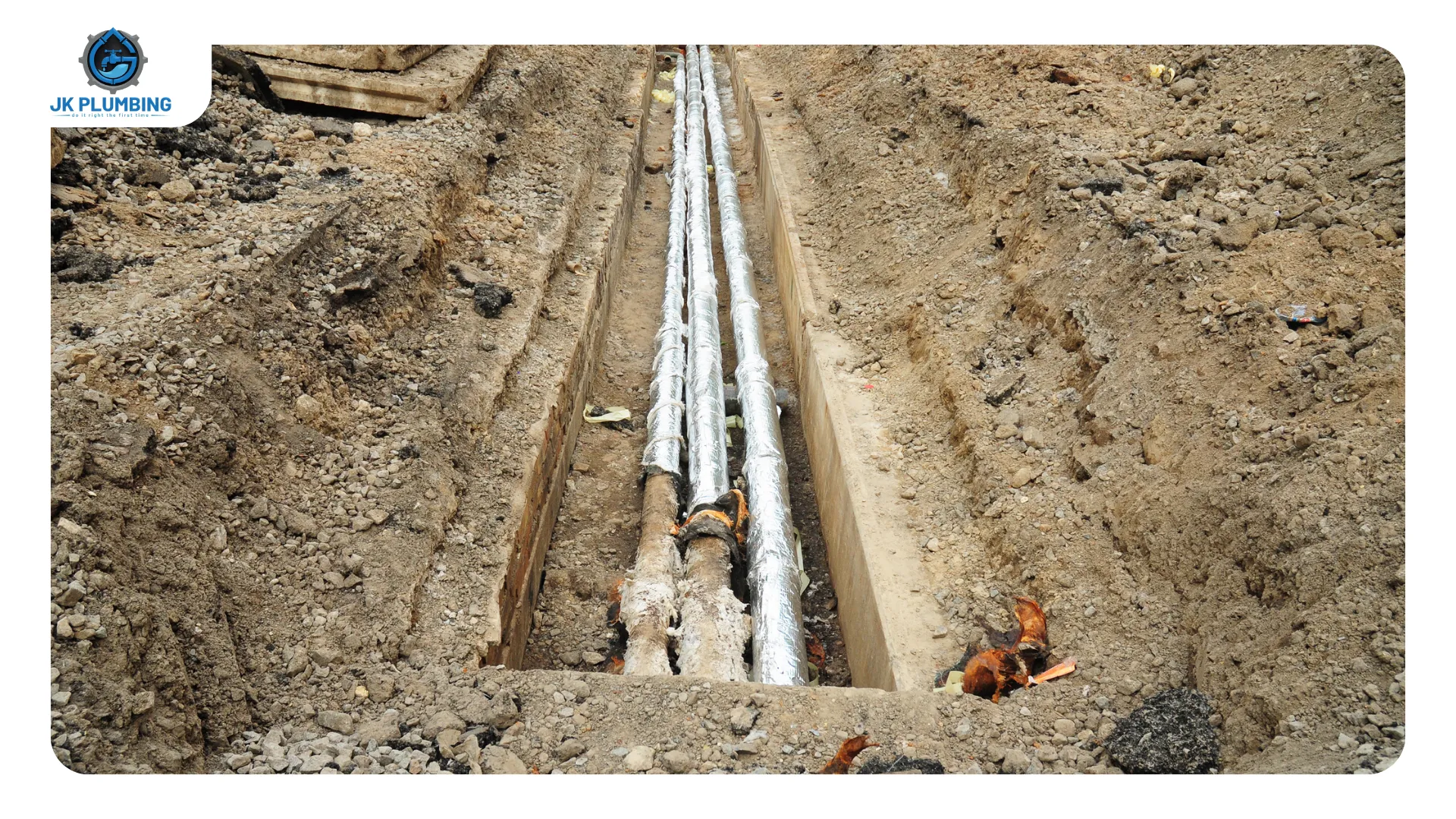
How is the line checked before anyone quotes on it?
A CCTV camera survey, and in South San Francisco that survey does double duty.
The City assesses a closed-circuit video of the lateral performed by a licensed contractor, with the video, the inspection report and the certificate application submitted to its engineering development team. The same footage that tells you what your pipe is made of and where it has failed is the footage the City wants to see.
That matters practically: a survey done properly to the City’s video requirements is one job, not two. A survey done casually for a quote and then redone to City standard is two.
What the footage establishes, in order: the material, the defects and where they sit, whether there are bellies and how deep, the depth and route of the line, and the condition of the connection at the main. Every number in a replacement quote follows from those five things, which is why a price quoted before anyone has put a camera down the line is a guess.
How long is the driveway or yard out of action?
Shorter than people fear for trenchless, longer than they hope for open-cut.
Trenchless replacement on a typical lot is usually a one to two day job. The disruption is concentrated at the access pits rather than spread along the run, so a driveway with a pit at each end is passable again quickly once those are backfilled and restored.
Open-cut replacement depends on length, depth and what’s above the line. A short run across lawn is quick. A full-length replacement under a concrete driveway involves breaking out, excavating, laying to grade, backfilling, compacting — and then the surface has to be restored, which is its own trade and its own cure time. Concrete restoration in particular means the surface is unusable for days after the plumbing is finished.
The hybrid case — open-cut on a bellied section, trenchless on the rest — lands in between, and is frequently the shortest total disruption for a line that needs both.
What we’ll give you before work starts is a sequence with dates, including when the surface is walkable and when it’s drivable, because those are different days.
What makes one job cost double another?
We don’t publish figures for replacement, because the spread between a short lawn run and a deep full-length replacement under a driveway with right-of-way restoration is enormous, and a number on a page would mislead one of those two homeowners.
What actually drives it:
- Length and depth of the run. Depth matters more than length: a deeper line means more excavation, more spoil and sometimes shoring.
- Material and condition — whether the line can be burst, has to be dug, or needs descaling first.
- Bellies, because each one forces excavation at that point regardless of the method used elsewhere.
- What’s on top — lawn, versus concrete driveway, versus mature landscaping, versus the public right-of-way.
- Surface restoration, which on concrete and in the right-of-way is a significant item in its own right.
- Permits and inspections, including the City’s compliance process.
If you want the cost conversation specifically, our guide to sewer line repair costs in South San Francisco goes into the repair side. For a replacement, call (415) 359-4588 and we’ll camera the line first and quote in writing after.
Where we work
Across South San Francisco — Sunshine Gardens, Serra Highlands, Sign Hill, Avalon Park, Westborough and Old South San Francisco — plus San Bruno, Millbrae, Colma, Daly City and down the Peninsula to Burlingame.
JK Plumbing performs the CCTV inspection, the compliance certificate work and the replacement itself, so the survey that satisfies the City and the repair that follows are one job with one contractor. We hold California contractors’ licence #1080266, verifiable through the Contractors State License Board — worth checking for anyone you’re considering.
The short version for a post-war home here: find out what the pipe is made of before anyone tells you what to do about it.
Frequently asked questions
What is the lateral actually made of on a house built in the forties or fifties?
Usually vitrified clay, cast iron, or bituminized fibre conduit — Orangeburg. Clay cracks and admits roots at its joints. Cast iron scales internally and eventually rusts through at the invert. Fibre conduit, a tarred wood-pulp tube used through the post-war boom, deforms rather than cracking: the bore goes oval, blisters and delaminates. A camera survey identifies which you have.
Trenchless or dig it up — which does a typical lot here allow?
Post-war Peninsula lots suit trenchless more often than San Francisco’s do, given a front setback and a straightforward run to the street. Trenchless needs a continuous path and a host pipe that suits the method. Open-cut wins where a section has collapsed, where the route changes, or where a belly needs re-grading. What sits on top — driveway, mature trees, patio — usually decides it.
What does replacement cost, and what makes one job double another?
We quote in writing after a camera survey rather than publishing figures, because the spread between a short lawn run and a deep full-length replacement under concrete is very large. The drivers are the run’s length and especially its depth, the pipe material and condition, the number of bellies, what sits above the line, surface restoration, and permits and inspections.
How long is the driveway or yard out of action?
Trenchless replacement on a typical lot is usually one to two days, with disruption concentrated at the access pits. Open-cut depends on length, depth and the surface above — a concrete driveway adds break-out, compaction and restoration with its own cure time, so the surface stays unusable for days after the plumbing finishes. A hybrid job lands in between.
How is the line checked before anyone quotes on it?
With a CCTV camera survey, which in South San Francisco doubles as the City’s requirement: a closed-circuit video by a licensed contractor, submitted with the inspection report and certificate application. The footage establishes material, defects and their locations, bellies and their depth, the line’s depth and route, and the condition of the connection at the main.
How long does a sewer lateral last, and does the compliance certificate reflect that?
Clay and cast iron laterals commonly run sixty years or more; fibre conduit was rated around fifty in ideal ground and has often failed well short of it. South San Francisco’s certificate durations mirror the difference: ten years where no repairs or only partial repairs were done, twenty-five where the entire lateral was replaced. Properties on an active certificate, those served by the Westborough Water District, and multi-unit buildings sharing one lateral are exempt.
Visit or Call Us
JK Plumbing
Adress:1008 Edwards Rd Burlingame, CA 94010
Phone: (415) 359-4588
Hours: Open 24 hours, seven days a week.
Serving San Francisco, South San Francisco, Daly City, Brisbane and the Peninsula.
CA License #1080266
RECENT POSTS