- Open 24 Hours Mon–Sat
- contact@jkplumbingsf.com
- +1 (415) 359-4588
- CA License #1080266

When water is spreading beyond your own home. In a flat, a leak stops being a plumbing problem and becomes someone else’s ceiling within minutes. JK Plumbing answers around the clock, Monday through Saturday, across San Francisco and Pacifica. Call (415) 359-4588.
By Alik, Owner & Master Plumber · Last updated November 2026
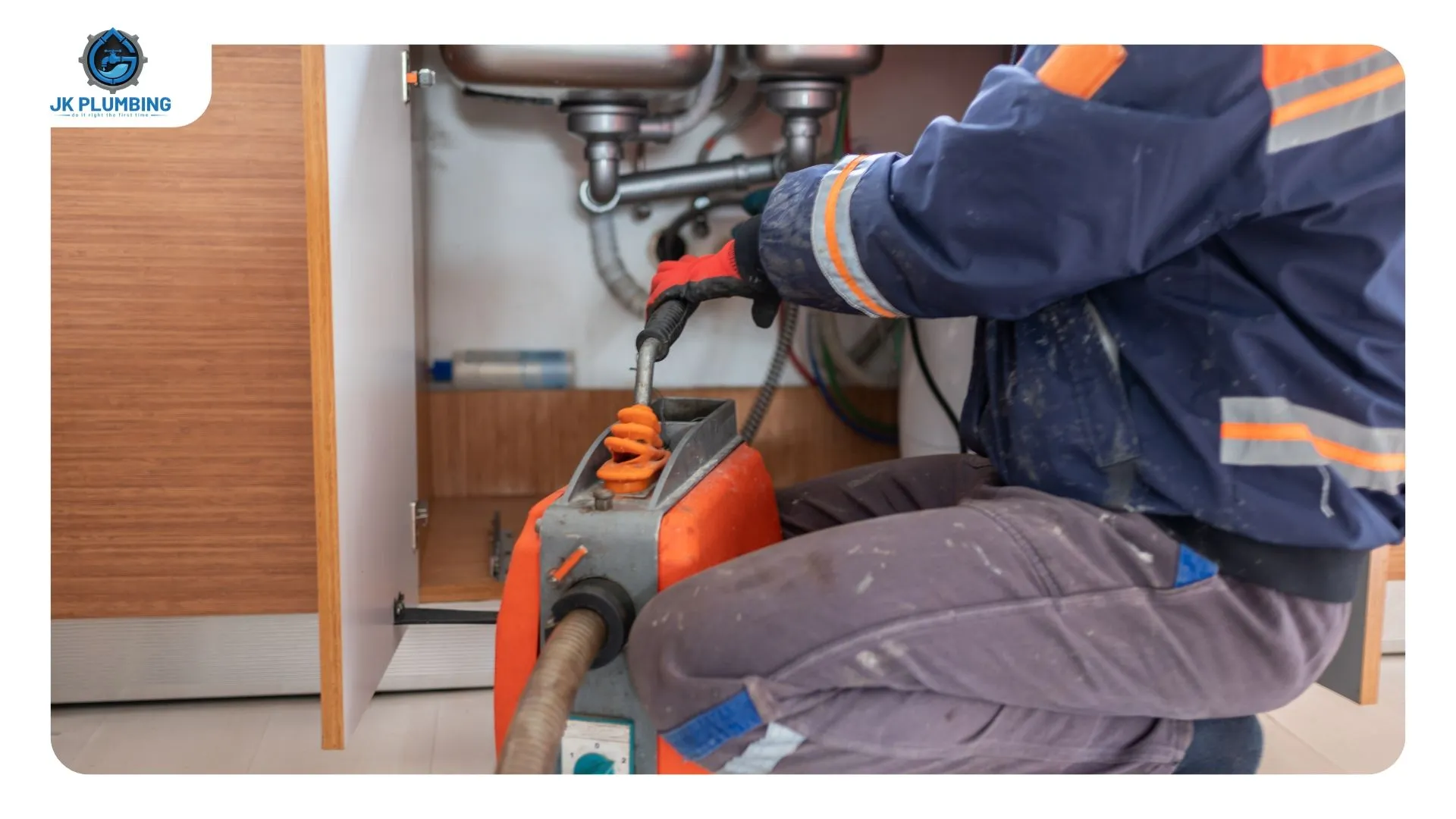
The first five minutes when water is reaching the flat below
Order matters more than speed here, and most people do these in the wrong sequence.
Stop the water before you do anything else. Not photograph it, not knock on the neighbour’s door, not look for a bucket. Everything else is recoverable; the volume of water is the only thing still getting worse.
Start at the nearest fixture stop. Under the sink, behind the toilet, at the supply to the appliance. If the source is obvious and that valve turns, you may be done in thirty seconds.
If that doesn’t do it, go up a level to the flat’s own shutoff, and if there isn’t one, to the building main. More on finding those below.
Then kill power to the affected area if water is near outlets, a light fitting below, or a panel. Only if you can reach the breaker safely and dry.
Then tell the flat below. Not because of liability — because water in a ceiling cavity is sitting above their light fixtures, and they need to move what’s underneath it and stay out from under a sagging ceiling.
Then photograph everything, before anyone starts mopping. Standing water, the source, the ceiling below. This takes ninety seconds and it is the difference between a straightforward insurance conversation and a contested one.
Then call us. By this point the leak is contained rather than spreading, which changes what we arrive to.
The single most common mistake is spending the first four minutes trying to identify which pipe failed. You don’t need to know. You need the water off, and the diagnosis happens afterwards.
Where is the shutoff in a building with several flats?
This is the question worth answering on a calm afternoon rather than at 2am, because in San Francisco’s older buildings the answer is frequently “not where you’d assume.”
There are four levels, and in a converted flat at least one of them usually doesn’t exist.
Fixture stops. Under sinks, behind toilets, at appliance supplies. These isolate one fixture. In buildings of a certain age they’re also the valves most likely to seize — a stop that hasn’t been turned in twenty years sometimes won’t.
A shutoff for your flat alone. Present in purpose-built apartment buildings. Frequently absent in a Victorian or Edwardian later divided into flats, because the conversion ran new branches off the original single supply without adding isolation per unit. If you have one it’s usually near where the supply enters your floor — a closet, under a stair, in the kitchen.
The building main. Usually in the ground-floor garage, a utility area, or on the exterior in line with the sidewalk water meter. The SFPUC’s guidance on locating your home water shutoff valve describes what you’re looking for: a cylindrical tank supply valve, sometimes painted red, or an older gate valve you turn clockwise until it stops, or a ball valve with a blue handle that turns ninety degrees to the pipe.
The meter — which is not yours to touch. SFPUC states plainly that water meters should only be accessed by its field staff, to prevent injury and damage to the equipment. If a plumber or a neighbour suggests shutting the building off at the meter, that’s the wrong move.
The consequence for a flat dweller is uncomfortable and worth saying out loud: if your building has no per-unit shutoff, stopping your leak means shutting off water to every flat in the building. That’s the right call at 2am and you should make it without hesitating — but it’s also the reason the next section exists.
Do this now, not later. SFPUC offers a courtesy site visit to help you find your property’s main shutoff, through Customer Services on 415-551-3000. Ten minutes on a weekday afternoon, and you’ll never again be the person in a dark garage at 2am trying three valves to see which one does something.

Who needs to be told when it affects more than one home?
Three groups, in this order, and early notification is what keeps a water incident from becoming a dispute.
The affected neighbour, immediately. Even at 3am. A ceiling holding water is a safety issue in their home, and they would rather be woken than wake up to it.
The owner, manager or HOA. In an owner-occupied flat that may be you. In a rented flat it isn’t, and the owner needs to know that night rather than on Monday — repairs to shared plumbing, and any claim, are generally theirs to authorise. If the building has a manager or an HOA with shared-system responsibility, the same applies.
Insurers, once the water is off. Yours and, where another home is affected, theirs. This is where your ninety seconds of photographs earns its keep.
What we won’t do is tell you who ends up paying. That depends on the cause, on where the failed component sits, and on the building’s own documents — and a plumber asserting an answer to it at 2am is a plumber guessing. We’ll document what failed and where, in writing, which is the part that actually helps you.
How does night-time access and parking affect how fast help arrives?
More than distance does, and this is the part no one thinks about until it costs them twenty minutes.
The street door. A technician who can’t get into the lobby is a technician standing on the pavement. Buzzers in older buildings are unreliable, there’s no on-site staff overnight in a two-to-six-unit building, and a key left with a manager is a key no one can reach at 2am. Send someone down to the street door.
The garage or basement. The building main is usually behind a door that locks, and the person with that key is sometimes a neighbour who is asleep. Worth knowing who holds it before you need it.
Parking. This is San Francisco at night in a residential permit zone. On a narrow street in the Mission or on a hill in Bernal Heights, a van carrying equipment sometimes parks further away than anyone would like, and the kit comes the rest of the way by hand.
Pacifica adds the drive. Coming down Highway 1 at night is quicker than the same trip at 6pm, but it’s a longer run than a call within the city, and we’ll tell you a realistic window when you call rather than a flattering one.
Three things that genuinely speed up the visit: someone waiting at the street door, the garage or utility room unlocked, and a clear path to the valve. The third one sounds trivial and isn’t — a building main behind stored bicycles and boxes costs real minutes.
Does a leak that only affects your own flat still count as urgent?
Often, yes — and “only affects my flat” is usually a conclusion drawn too early.
In a building with shared walls and floor cavities, water travels along joists and finds the next space down. Where you see it is where it emerged, not where it’s going. A leak that appears contained to your bathroom at midnight has frequently been wetting the structure between floors for some time.
Treat as urgent overnight: anything actively running that you can’t stop, water near electrics, any ceiling that’s stained, bulging or dripping, sewage of any kind, and a total loss of water.
Reasonable to hold until morning: a slow drip into a bucket from a fixture you’ve isolated, a single fixture out of service in a flat with another, and low pressure with no visible water.
The honest middle case is the leak you’ve stopped but can’t locate. That isn’t an overnight emergency once the water is off — but it is a next-day call rather than a next-week one, because the damage continues drying into materials either way.
What happens when you call us at 2am
A person answers. Not a form, not a callback promise.
The first thing we do is talk you through stopping the water, because that matters more than our arrival time and it’s happening while we’re still loading the van. If you haven’t found the shutoff, we’ll work through the levels with you over the phone.
Then we dispatch, and we give you a realistic arrival window based on where the technician is and where you are — a call in the Mission and a call in Pacifica are not the same drive, and we’d rather say so than quote a number that sounds good.
What arrives is a licensed technician under California contractors’ licence #1080266, equipped to stop and diagnose rather than just look. Overnight work is usually a make-safe: stop the leak, isolate the failure, restore water to the rest of the building where possible, and return in daylight for the permanent repair with the right parts.
To be straight about the limits of our coverage: we answer and dispatch around the clock Monday through Saturday. We’re closed Sunday. For a Sunday emergency, shut the water off, tell the neighbour and the owner, and call us first thing Monday — or if it’s a water-supply problem rather than one inside the building, your water provider’s emergency line is below.
Where we work
Across San Francisco — the Mission, Noe Valley, Bernal Heights, Potrero Hill, Glen Park, the Sunset and the Richmond — plus Pacifica, Daly City, Brisbane and South San Francisco.
Two numbers worth saving alongside ours, because some emergencies belong to the water provider rather than to a plumber. In San Francisco, SFPUC Customer Services is 415-551-3000. In Pacifica, the North Coast County Water District lists an after-hours technician on (650) 576-3788 for water emergencies outside business hours.
The rule of thumb: if the water is coming from inside the building, that’s us. If the street is flooding, pressure has vanished across the whole block, or the problem is at the meter, call the provider first.
For a flat emergency in San Francisco at any hour Monday through Saturday, call JK Plumbing on (415) 359-4588 — and shut the water off before you dial.
Frequently asked questions
Water is reaching the flat below — what do you do in the first five minutes?
Stop the water first: the fixture stop, then the flat’s shutoff, then the building main. Kill power to the affected area if water is near electrics and you can reach the breaker safely. Tell the flat below so they can move belongings and stay clear of a sagging ceiling. Photograph everything before mopping. Then call a plumber. Don’t spend those minutes identifying which pipe failed.
Where is the shutoff in a building with several flats?
There are four levels: fixture stops, a shutoff for your flat, the building main, and the meter. Converted Victorians and Edwardians frequently have no per-unit shutoff, so the building main — usually in the ground-floor garage or in line with the sidewalk water meter — is the only option, and using it stops water to every flat. The meter itself should only be accessed by SFPUC field staff.
Who needs to be told when it affects more than one home? The affected neighbour immediately, even overnight, because a water-filled ceiling is a safety issue in their home. Then the owner, manager or HOA, since repairs to shared plumbing and any claim are generally theirs to authorise. Then insurers, once the water is off. Who ultimately pays depends on the cause and the building’s documents, not on a plumber’s opinion at 2am.
How does night-time access and parking affect how fast help arrives? Often more than distance. Buzzers in older buildings are unreliable and small San Francisco buildings have no overnight staff, so someone should wait at the street door. The building main is usually behind a locked garage or utility door. Residential permit parking on narrow or steep streets can mean carrying equipment from further away. Pacifica adds the drive down Highway 1.
Does a leak that only affects your own flat still count as urgent? Usually it’s more urgent than it looks, because water travels along joists and appears somewhere other than its source. Treat as overnight emergencies: anything running you can’t stop, water near electrics, a stained or bulging ceiling, sewage, and total loss of water. A slow drip from an isolated fixture can wait for morning. A leak you’ve stopped but can’t locate is a next-day call.
Do you cover Sunday? No. JK Plumbing answers and dispatches around the clock Monday through Saturday and is closed Sunday. For a Sunday emergency, shut the water off at the nearest working valve, notify the neighbour and the building owner, photograph the damage, and call us first thing Monday. If the problem is with the water supply itself rather than inside the building, contact SFPUC on 415-551-3000, or in Pacifica the North Coast County Water District after-hours technician on (650) 576-3788.
Visit or Call Us
JK Plumbing
Adress:1008 Edwards Rd Burlingame, CA 94010
Phone: (415) 359-4588
Hours: Open 24 hours, seven days a week.
Serving San Francisco, South San Francisco, Daly City, Brisbane and the Peninsula.
CA License #1080266
RECENT POSTS