- Open 24 Hours Mon–Sat
- contact@jkplumbingsf.com
- +1 (415) 359-4588
- CA License #1080266

A side sewer is the private drain line running from your building out to the City sewer main under the street. In San Francisco it splits at the curb into an upper and a lower section, and those two halves are repaired, permitted and paid for differently. JK Plumbing handles sewer line services across San Francisco. Call (415) 359-4588.
By Alik, Owner & Master Plumber · Last updated November 2026
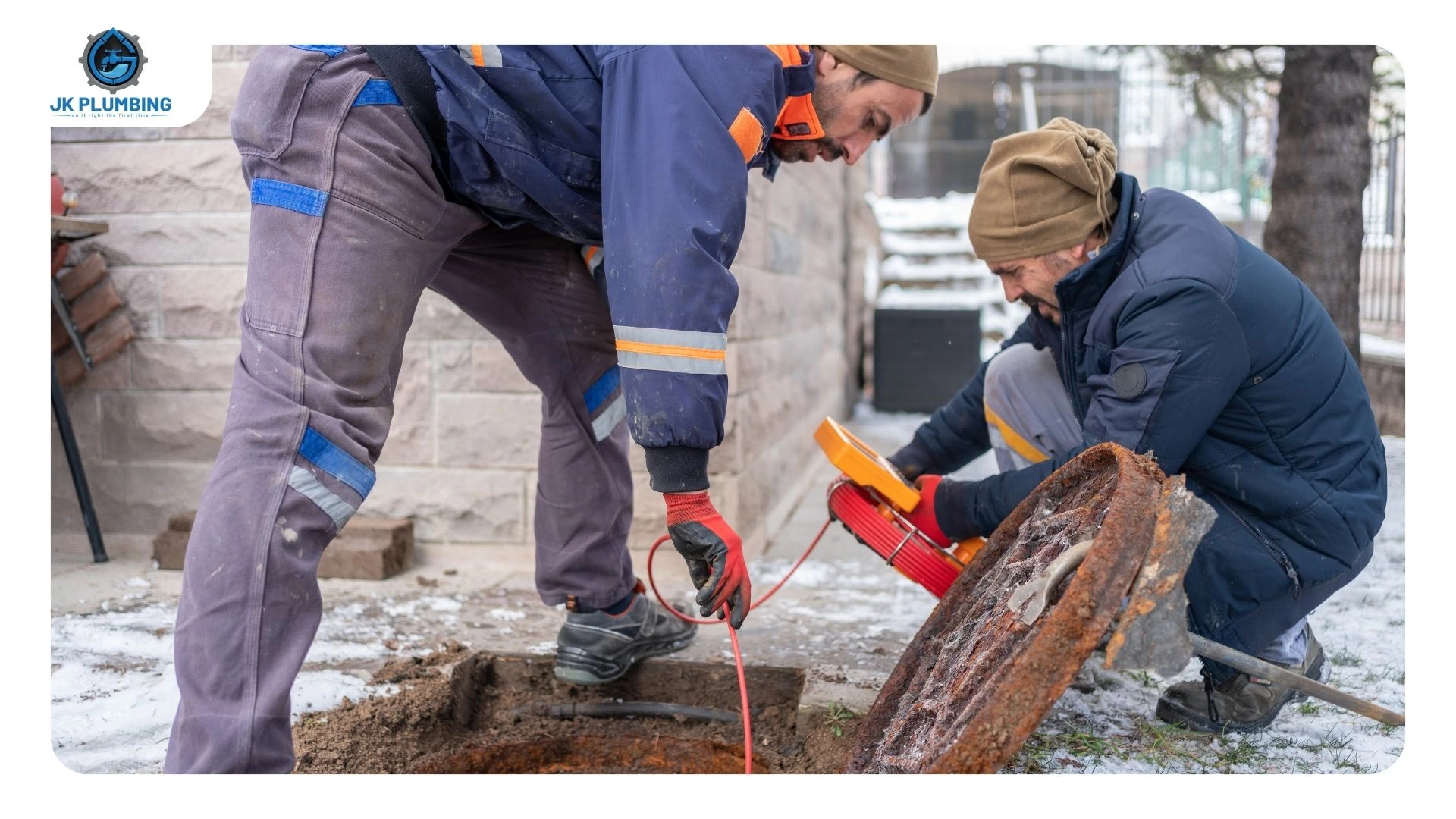
What is a side sewer, and where does yours actually run?
“Side sewer” isn’t plumber’s slang — it’s the City’s own term. San Francisco Public Works issues a Side Sewer Permit for work on the lateral in the public right-of-way, and the way that permit is drawn tells you where the line is divided.
The cleanout sits at the curb. San Francisco’s sewer lateral specification requires the cleanout assembly — the P-trap, the riser and the vent — to be installed within two feet of the face of the curb. That small cast iron cover in the sidewalk near the gutter is it. Not decoration, not a water meter.
That cleanout is also the boundary. The upper lateral is the portion from the building to the curb line, including the cleanout. The lower lateral is the portion inside the City’s right-of-way, from the curb out to the main.
The spec sets the rest. Pipe is extra-strength vitrified clay or HDPE. Minimum diameter is six inches for a single-family home and eight for a multifamily or commercial building. The lower lateral runs at a minimum slope of a quarter inch per foot, with at least four feet of cover at its upstream end.
Six inches versus eight is why a flat conversion sometimes needs an upsize rather than a like-for-like replacement, and the four-foot cover requirement is why “just dig it up” is a bigger sentence at the curb than in your back garden.
Who owns the lateral — and who actually pays for the half under the street?
This is where most San Francisco homeowners are working from bad information, and it’s worth being precise because the two halves of the answer point in opposite directions.
Ownership: the SFPUC owns the main under the street. You own the entire lateral — upper, lower, vent and trap. The City’s guidance on taking care of your sewer lateral states it plainly: the entire sewer lateral belongs to the property owner.
Payment: not the same question. For the upper lateral, the trap and the vent, you hire a licensed plumber and you pay. For the lower lateral, the section from the curb to the main, the process is different. If a plumber finds a problem that routine maintenance can’t resolve, the owner files a 311 service request. SFPUC inspects it, and under most circumstances the City performs the needed repair or replacement at no cost to the owner.
That reverses the usual assumption. The part of the line most expensive to dig is frequently the part you don’t pay to dig.
The caveats are real. “Most circumstances” is the City’s wording, not a guarantee, and SFPUC’s inspection decides. It doesn’t cover the upper lateral, and it doesn’t apply to a voluntary full replacement during a remodel, which is a private job under a Side Sewer Permit. It also starts with a plumber’s finding, so the camera inspection comes first either way.
Practically: before anyone quotes a full lateral replacement, find out which section actually failed. If the defect is past the curb, the right first move may be a 311 request rather than a contract.
What happens when two buildings share one lateral?
Shared laterals are common in San Francisco — adjacent Victorians built by the same developer, a house later split into flats, two buildings on a lot where one was the original and one came later.
Here is the part nobody says out loud: the City’s documents don’t resolve it. Neither the SFPUC lateral specification nor the Side Sewer Permit guidance addresses a lateral serving more than one building. The spec defines the lower lateral by reference to the “benefitted property,” singular, and goes no further.
So a shared lateral is a private matter between owners, governed by deeds, recorded easements and whatever the title report says, not by a plumbing rule. In practice that produces a predictable sequence:
Confirm the line is genuinely shared. A camera inspection from both buildings’ cleanouts is the only reliable way. Assumed shared laterals turn out separate often enough to be worth the hour, and the reverse happens too.
Find the junction. Where the two buildings’ lines meet determines everything about cost. A defect upstream of the junction is one owner’s. A defect downstream is everyone’s. SFPUC can help locate existing lines, including side sewers, through its sewer inspections team.
Check the title documents before the negotiation. An easement may already allocate responsibility. If it doesn’t, the owners are negotiating from scratch, and that goes better before the trench is open than after.
Expect owners to authorise the work, not residents. The person who notices the backup is frequently not the person who can approve the repair.
We work on shared laterals and will inspect from both sides. What we won’t do is adjudicate the split between neighbours — that’s a title question.
Why do laterals fail under sidewalks and front steps first?
Because that stretch has more going on in it than any other part of the line.
It’s the fitting-dense section. Straight pipe rarely fails on its own. Joints, bends and transitions do. The curb area holds the P-trap, the riser and the vent — direction changes and connections concentrated in a few feet of line.
Clay joints are an invitation. Extra-strength vitrified clay is a permitted material and a great deal of San Francisco’s older lateral stock is clay. Clay comes in short lengths, which means a joint every few feet, and roots find joints.
The trees above it are the City’s. San Francisco Public Works maintains more than 125,000 street trees and the surrounding sidewalks, following the 2016 ballot measure that moved responsibility from property owners to the City. Those trees are planted in the strip directly over the section of your lateral that’s richest in joints. Roots go where water and nutrients are, and a hairline crack in a clay joint supplies both.
Load and movement. Front steps, light wells and entry stairs in this city are often built over the lateral run, adding dead load above a pipe that was laid before the structure existed. Add the differential settlement you get where a building’s foundation meets undisturbed ground at the property line and you have a hinge point in the middle of a rigid clay pipe.
It’s the oldest part of the system in most buildings. Interior drains get replaced during kitchen and bathroom remodels. The run under the front steps gets replaced when it fails.
So when a camera finds the defect near the curb, that isn’t bad luck. That’s where the odds always were.
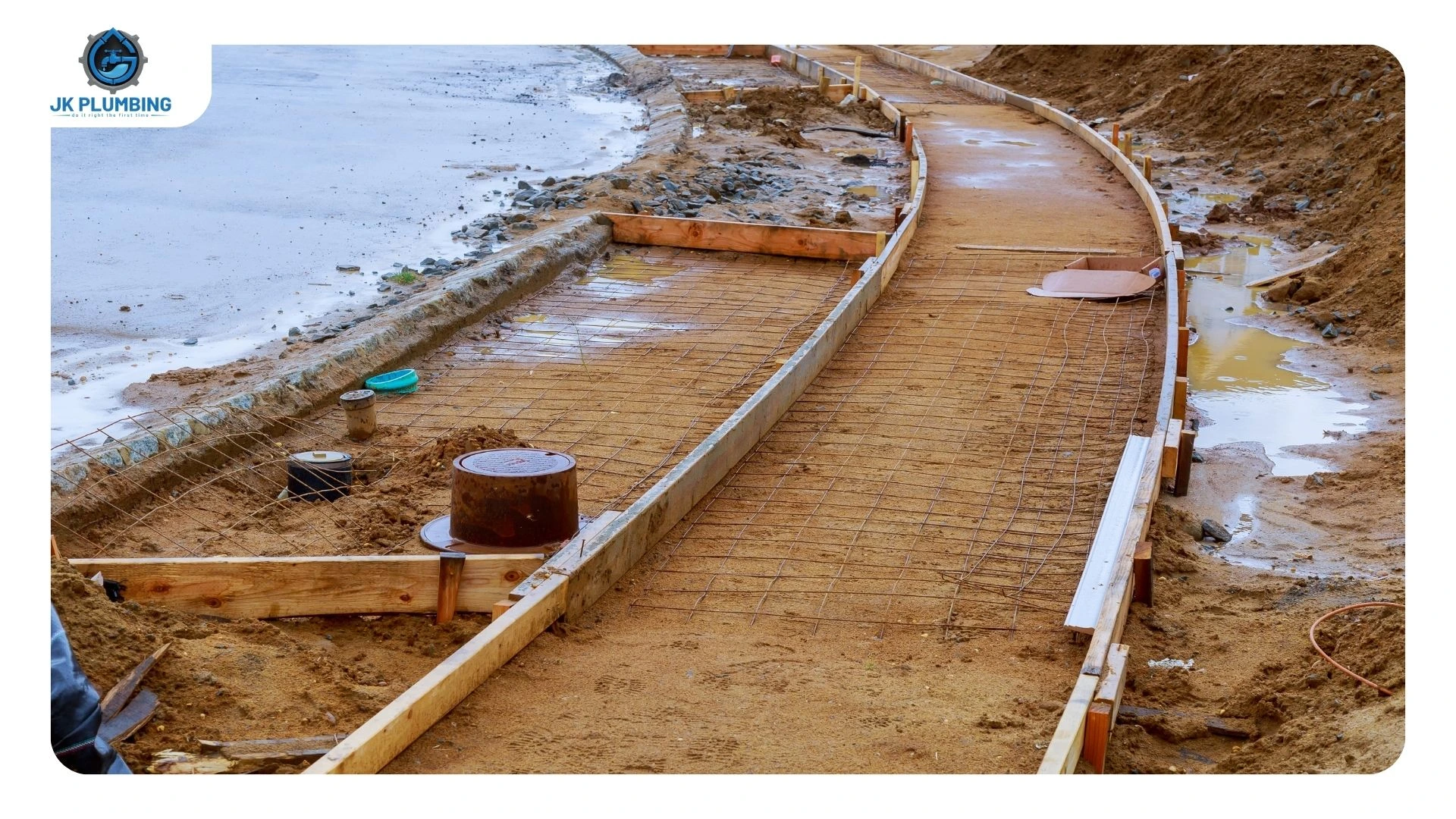
How does a sloped lot change the repair?
San Francisco’s hills change the engineering, and not in the direction people expect.
Downhill lots are the easy case. Where the house sits above the street — the standard arrangement across Noe Valley, Bernal Heights and Potrero Hill — gravity is working for you. The minimum quarter-inch-per-foot fall is easily exceeded, and the usual complication is access rather than grade.
Uphill lots are the hard case. Where the building sits below street grade, the lateral has to reach a main that is higher than the floor it’s draining. Getting the required fall out to the main while also maintaining the four feet of cover at the upstream end of the lower lateral is sometimes geometrically impossible. That’s when you’re looking at a much deeper excavation, a re-routed line, or an ejector pump — which is a mechanical system with a lifespan and a power requirement, not a one-time fix.
Steep sites complicate the dig. A trench on a slope needs shoring a flat one doesn’t, and spoil and pipe have to be staged somewhere on a lot that may have nowhere flat.
Too much fall is its own problem. On a very steep run, water outruns solids and leaves them behind, producing recurring blockages in a line with no structural defect. A camera distinguishes the two, and the fix is grade correction rather than pipe replacement.
Which is why a quote given over the phone isn’t worth much here. The slope of the lot is an input to the repair, and so is which direction it slopes.
Can a lateral be fixed without taking up the front steps?
Usually, yes — and this is the main reason trenchless methods matter in this city, where what sits above the line is frequently a tiled entry stair, a mature garden or a finished light well.
Pipe bursting pulls a new pipe along the path of the old one, fracturing the original outward as it goes. It needs an access pit at each end rather than a continuous trench. Worth knowing: the City’s spec permits HDPE as a lateral material, which is exactly what bursting installs. Trenchless replacement here is a spec-compliant method, not a workaround.
Cured-in-place lining (CIPP) inserts a resin-saturated liner into the existing pipe and cures it into a new pipe within the old one. It suits a structurally intact line with cracks and root intrusion, and it slightly reduces the internal diameter — which is why that six-inch minimum matters when deciding whether lining is appropriate.
Open-cut still wins in specific cases: a collapsed line with no path for a bursting head, a section that has to be re-graded rather than replaced in place, or a change of route.
Trenchless reduces excavation; it doesn’t eliminate it. You still need access pits, the cleanout at the curb generally has to be exposed, and the connection at the main is a dig — with restoration by a licensed paving contractor, per the permit.
So the accurate answer is: the front steps usually stay, the sidewalk usually doesn’t.
The permits San Francisco actually requires
One sewer lateral job can touch three permit regimes, which is the single most common source of surprise.
The private side, building to trap: a General Excavation Permit, plus Department of Building Inspection plumbing permits for the pipe on the building side.
The right-of-way, trap to main: the Side Sewer Permit from San Francisco Public Works, which carries real requirements worth knowing before you compare bids:
- A licensed contractor holding Class A, or C-36 with C-12, or C-42.
- A certificate of liability insurance on file and a current Business Tax Registration Certificate.
- A Street Excavation Bond of at least $25,000, guaranteeing pavement maintenance for three years after backfill and paving.
- Pavement and sidewalk restoration performed by a licensed paving contractor.
- Inspection scheduled at least ten days before work begins.
- Underground service alert — 811 — at least 72 hours before excavating.
- Tow-away signage registered with SFMTA once the permit is approved.
- Written SFPUC approval where the lateral exceeds the standard six-inch diameter.
The permit fee is an administrative fee plus inspection fees, with simple projects typically charged four hours of inspection.
JK Plumbing pulls the Side Sewer Permit and does the right-of-way work directly, so the private side and the street side are one job rather than two contractors pointing at each other across the property line.
The three-year pavement bond is the detail worth carrying into any bid comparison. It’s a real cost of right-of-way work, and a quote dramatically under the others is sometimes a quote from someone not carrying it.
Where we work
Across San Francisco — Noe Valley, Bernal Heights, Potrero Hill, the Mission, Glen Park, the Sunset, the Richmond and Visitacion Valley — plus Brisbane, Daly City, South San Francisco and down the Peninsula to Burlingame.
Brisbane and Daly City run their own sewer systems with their own rules, so the permit path there is not San Francisco’s and we confirm it per job rather than assuming. Within San Francisco, the first step is almost always the same: a camera inspection that establishes which section of the line has failed, because that single fact determines the permit, the method and who pays.
If you’re seeing slow drains across multiple fixtures, gurgling, or backups in a ground-floor or garage fixture, that’s a lateral symptom rather than a fixture one. Call us at (415) 359-4588 and we’ll start at the cleanout.
Frequently asked questions
What is a side sewer and where does yours actually run?
It’s the private drain line from your building to the City sewer main, and it’s San Francisco’s official term — Public Works issues a Side Sewer Permit for the portion in the public right-of-way. It runs from the building, under the front yard and sidewalk, to the main under the street. The cleanout assembly, containing the trap, riser and vent, sits within two feet of the face of the curb and marks the boundary between the upper and lower sections.
What happens when two buildings share one lateral?
It becomes a private matter between the owners, because neither the SFPUC lateral specification nor the Side Sewer Permit guidance addresses laterals serving more than one building. Responsibility is determined by deeds and recorded easements rather than a plumbing rule. The practical steps are a camera inspection from both buildings to confirm the line is genuinely shared, locating the junction, and checking title documents before negotiating.
Why do laterals under sidewalks and front steps fail first?
That stretch concentrates the risks. It holds the trap, riser and vent, so it’s fitting-dense where straight pipe is not. Much of it is vitrified clay with a joint every few feet, and roots enter at joints. San Francisco maintains more than 125,000 street trees planted directly above that section. Front steps and light wells add load over pipe laid before they existed, and the property line is where differential settlement concentrates.
How does a sloped lot change the repair?
A house above street grade has gravity on its side and the usual issue is access. A house below street grade has to achieve the minimum quarter-inch-per-foot fall while keeping four feet of cover at the upstream end of the lower lateral, which can mean deep excavation, a re-route or an ejector pump. Very steep runs create the opposite problem — water outrunning solids, causing blockages in a line with no structural defect.
Can a lateral be fixed without taking up the front steps?
Usually. Pipe bursting pulls a new HDPE line along the old path from access pits at each end, and HDPE is a material the City’s spec permits. CIPP lining cures a new pipe inside the existing one where the line is structurally intact. Neither eliminates excavation entirely — the cleanout at the curb and the connection at the main still have to be exposed, and the sidewalk has to be restored by a licensed paving contractor.
Who owns the sewer lateral, and who pays to fix it?
You own the entire lateral, including the lower section under the street, the trap and the vent. Payment differs by section. The upper lateral is yours to repair. For the lower lateral, from the curb to the main, the owner files a 311 request, SFPUC inspects, and under most circumstances the City performs the repair or replacement at no cost. That does not apply to voluntary full replacements, and SFPUC’s inspection decides.
Visit or Call Us
JK Plumbing
Adress:1008 Edwards Rd Burlingame, CA 94010
Phone: (415) 359-4588
Hours: Open 24 hours, seven days a week.
Serving San Francisco, South San Francisco, Daly City, Brisbane and the Peninsula.
CA License #1080266
RECENT POSTS